
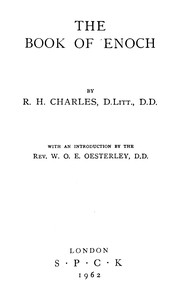
The book of Enoch
by Anonymous
- Language
- EN
- Format
- EPUB
Description
The Book of Enoch (also 1 Enoch; Hebrew: סֵפֶר חֲנוֹךְ, romanized: Sēfer Ḥănōḵ; Ge'ez: መጽሐፈ ሄኖክ, romanized: Maṣḥafa Hēnok) is an ancient Jewish apocalyptic religious text, ascribed by tradition to the patriarch Enoch who was the father of Methuselah and the great-grandfather of Noah. The Book of Enoch contains unique material on the origins of demons and Nephilim, why some angels fell from heaven, an explanation of why the Genesis flood was morally necessary, and a prophetic exposition of the thousand-year reign of the Messiah. Three books are traditionally attributed to Enoch, including the distinct works 2 Enoch and 3 Enoch.
1 Enoch is not considered to be canonical scripture by most movements of Judaism or branches of Christianity, although it is part of the biblical canon used by the Ethiopian Jewish community Beta Israel, as well as the Ethiopian Orthodox Tewahedo Church and Eritrean Orthodox Tewahedo Church.
The older sections of 1 Enoch are estimated to date to c. 300–200 BCE, and the latest part (Book of Parables) is probably from c. 100 BCE. Scholars believe Enoch was originally written in either Aramaic or Hebrew, the languages first used for Jewish texts. Ephraim Isaac suggests that the Book of Enoch, like the Book of Daniel, was composed partially in Aramaic and partially in Hebrew. No Hebrew version is known to have survived. Copies of the earlier sections of 1 Enoch were preserved in Aramaic among the Dead Sea Scrolls in the Qumran Caves.
Authors of the New Testament were also familiar with some content of the book. A short section of 1 Enoch is cited in the Epistle of Jude, being attributed to "Enoch, the Seventh from Adam" (1 Enoch 60:8). The full Book of Enoch survives in its entirety only in the Geʽez translation. (This summary is from Wikipedia.)
1 Enoch is not considered to be canonical scripture by most movements of Judaism or branches of Christianity, although it is part of the biblical canon used by the Ethiopian Jewish community Beta Israel, as well as the Ethiopian Orthodox Tewahedo Church and Eritrean Orthodox Tewahedo Church.
The older sections of 1 Enoch are estimated to date to c. 300–200 BCE, and the latest part (Book of Parables) is probably from c. 100 BCE. Scholars believe Enoch was originally written in either Aramaic or Hebrew, the languages first used for Jewish texts. Ephraim Isaac suggests that the Book of Enoch, like the Book of Daniel, was composed partially in Aramaic and partially in Hebrew. No Hebrew version is known to have survived. Copies of the earlier sections of 1 Enoch were preserved in Aramaic among the Dead Sea Scrolls in the Qumran Caves.
Authors of the New Testament were also familiar with some content of the book. A short section of 1 Enoch is cited in the Epistle of Jude, being attributed to "Enoch, the Seventh from Adam" (1 Enoch 60:8). The full Book of Enoch survives in its entirety only in the Geʽez translation. (This summary is from Wikipedia.)
Summary
The Book of Enoch (also 1 Enoch; Hebrew: סֵפֶר חֲנוֹךְ, romanized: Sēfer Ḥănōḵ; Ge'ez: መጽሐፈ ሄኖክ, romanized: Maṣḥafa Hēnok) is an ancient Jewish apocalyptic religious text, ascribed by tradition to the patriarch Enoch who was the father of Methuselah and the great-grandfather of Noah. The Book of Enoch contains unique material on the origins of demons and Nephilim, why some angels fell from heaven, an explanation of why the Genesis flood was morally necessary, and a prophetic
FAQ
Is "The book of Enoch" free to download?
Yes, it is free to download — no sign up needed.
What format is the file?
EPUB.
Reader reviews Be the first
No reviews yet. Be the first to review this book.
Write a review
Protected by reCAPTCHA.
More by Anonymous

Library of the World's Best Literature, Ancient and Modern — Volume 05
Anonymous
No ratings yet
The World's Greatest Books — Volume 13 — Religion and Philosophy
Anonymous
No ratings yet
The Parochial History of Cornwall, Volume 2 (of 4)
Anonymous
No ratings yet

The Book of the Thousand Nights and a Night — Volume 06 (of 10)
Anonymous
No ratings yet
The Life of Lazarillo de Tormes: His Fortunes & Adversities; with a Notice of the Mendoza Family, a Short Life of the Author, Don Diego Hurtado De Mendoza, a Notice of the Work, and Some Remarks on the Character of Lazarillo de Tormes
Anonymous
No ratings yet
Sindbad the Sailor, & Other Stories from the Arabian Nights
Anonymous
No ratings yet