
Your download link has expired — please click the download button again.
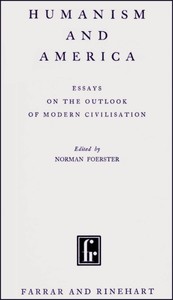
Humanism and America : $b Essays on the outlook of modern civilisation
by Anonymous
- Language
- EN
- Format
- EPUB
- Size
- 435 KB
Description
"Humanism and America" by Norman Foerster is an edited collection of essays written in the early 20th century. It argues for a disciplined, classical humanism as a corrective to modern scepticism, scientism, and cultural disarray, especially in the United States. The volume surveys ethics, religion, literature, the arts, and education through contributions from leading critics and scholars.
The opening of the collection presents a preface that diagnoses a modern “headache” of noise, disillusion, and naturism, and proposes humanism—defined by clear standards and a firm distinction between man, nature, and the divine—as a restorative discipline. The editor situates American humanism chiefly in the work of Irving Babbitt and Paul Elmer More, rebuts charges that humanists are academic, un-American, reactionary, or puritanical, and sets the book’s aim: to clarify terms, restore standards, and address contemporary life across the arts and public discourse. The first essay, by Louis Trenchard More, restricts true science to quantitative laws about the objective world, exposes the overreach of pseudo-sciences like psychology and sociology, retraces the historical split between objective method and subjective life from Galileo, Descartes, and Newton, and criticizes modern hypotheses (æthers, electrons, relativity, quanta) when treated as metaphysical truth. The next essay, by Irving Babbitt, defines humanism as allegiance to the law of measure, decorum, and poise—distinct from humanitarian sentiment—and argues for a stable centre in human nature, drawing parallels with Confucian thought, acknowledging religion’s support, and grounding ethics in a higher will that disciplines temperament. Together, these opening sections set the terms and program: replacing relativism and scientism with standards rooted in character, discrimination, and measure. (This is an automatically generated summary.)
The opening of the collection presents a preface that diagnoses a modern “headache” of noise, disillusion, and naturism, and proposes humanism—defined by clear standards and a firm distinction between man, nature, and the divine—as a restorative discipline. The editor situates American humanism chiefly in the work of Irving Babbitt and Paul Elmer More, rebuts charges that humanists are academic, un-American, reactionary, or puritanical, and sets the book’s aim: to clarify terms, restore standards, and address contemporary life across the arts and public discourse. The first essay, by Louis Trenchard More, restricts true science to quantitative laws about the objective world, exposes the overreach of pseudo-sciences like psychology and sociology, retraces the historical split between objective method and subjective life from Galileo, Descartes, and Newton, and criticizes modern hypotheses (æthers, electrons, relativity, quanta) when treated as metaphysical truth. The next essay, by Irving Babbitt, defines humanism as allegiance to the law of measure, decorum, and poise—distinct from humanitarian sentiment—and argues for a stable centre in human nature, drawing parallels with Confucian thought, acknowledging religion’s support, and grounding ethics in a higher will that disciplines temperament. Together, these opening sections set the terms and program: replacing relativism and scientism with standards rooted in character, discrimination, and measure. (This is an automatically generated summary.)
FAQ
Is "Humanism and America : $b Essays on the outlook of modern civilisation" free to download?
Yes, it is free to download — no sign up needed.
What format is the file?
EPUB.
More by Anonymous





Reader reviews Be the first
No reviews yet. Be the first to review this book.
Write a review
Protected by reCAPTCHA.