
Your download link has expired — please click the download button again.
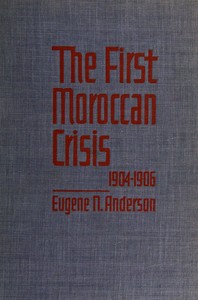
The first Moroccan crisis, 1904-1906
- Language
- EN
- Format
- EPUB
- Size
- 805 KB
Description
"The first Moroccan crisis, 1904-1906" by Eugene Newton Anderson is a historical study written in the early 20th century. It analyzes how the Moroccan question became a test of European diplomacy, tracing the alignments, rivalries, and calculations that set the stage for later pre-war crises. The focus is on the interplay between France, Germany, Britain, Spain, Italy, and Russia, with Morocco’s internal instability serving as the catalyst and backdrop.
The opening of this study explains that the book treats Morocco chiefly as a stage for European power politics, arguing that the first Moroccan crisis fixed mindsets and alignments for later confrontations. It outlines sources (notably British and German document collections and French “Livres jaunes”), flags the thin French archival record, and frames diplomacy as the choices of a few key actors under the pressure of public opinion. The narrative then sketches Morocco’s decay under Sultan Abd-el-Aziz—financial folly, revolts, insecurity—and shows France advancing a “pacific penetration” via Algeria while publicly affirming the sultan’s sovereignty. Early steps include flexible frontier arrangements, military and financial assistance to the sultan, and the failure of Moroccan appeals to Britain and Germany. Next, the work describes the Franco-Italian entente: secret understandings that traded freedom of action in Morocco for Italy’s latitude in Tripoli and pledged Italian neutrality if France fought after “direct provocation,” blunting anti-French edges of the Triple Alliance. It closes this opening portion by setting up Spain’s weakened post-1898 position and its anxious stake in northern Morocco, paving the way for a Franco-Spanish understanding. (This is an automatically generated summary.)
The opening of this study explains that the book treats Morocco chiefly as a stage for European power politics, arguing that the first Moroccan crisis fixed mindsets and alignments for later confrontations. It outlines sources (notably British and German document collections and French “Livres jaunes”), flags the thin French archival record, and frames diplomacy as the choices of a few key actors under the pressure of public opinion. The narrative then sketches Morocco’s decay under Sultan Abd-el-Aziz—financial folly, revolts, insecurity—and shows France advancing a “pacific penetration” via Algeria while publicly affirming the sultan’s sovereignty. Early steps include flexible frontier arrangements, military and financial assistance to the sultan, and the failure of Moroccan appeals to Britain and Germany. Next, the work describes the Franco-Italian entente: secret understandings that traded freedom of action in Morocco for Italy’s latitude in Tripoli and pledged Italian neutrality if France fought after “direct provocation,” blunting anti-French edges of the Triple Alliance. It closes this opening portion by setting up Spain’s weakened post-1898 position and its anxious stake in northern Morocco, paving the way for a Franco-Spanish understanding. (This is an automatically generated summary.)
FAQ
Is "The first Moroccan crisis, 1904-1906" free to download?
Yes, it is free to download — no sign up needed.
What format is the file?
EPUB.
Reader reviews Be the first
No reviews yet. Be the first to review this book.
Write a review
Protected by reCAPTCHA.