
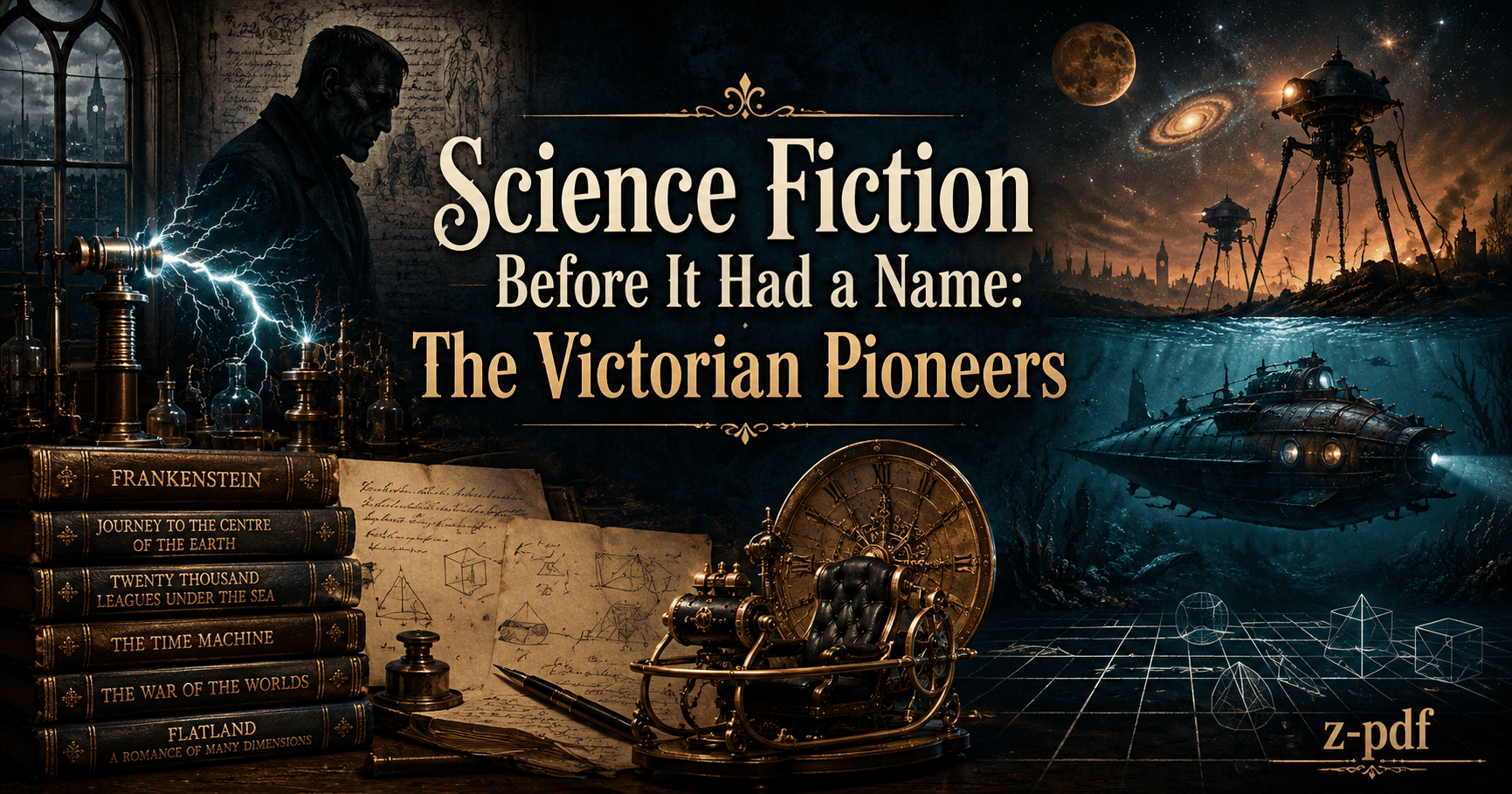
We think of science fiction as a modern invention, but its founding masterpieces were written before the phrase even existed. In the nineteenth and early twentieth centuries, a handful of visionary authors used the tools of fiction to ask what science might do to us, for good and ill. Their books are still thrilling, and because they are in the public domain, they are all free to read today. Here are the pioneers and where to begin.
Mary Shelley starts it all
Long before rockets and robots, an eighteen-year-old wrote the book many consider the first true science fiction novel. Frankenstein, published in 1818, imagines a scientist who creates life and then recoils from his creation. Shelley was not interested in the mechanics of the experiment but in its consequences: responsibility, isolation, and the ethics of making something you cannot control. Every cautionary tale about technology descends from her.
Jules Verne: the engineer's imagination
If Shelley gave the genre its conscience, Jules Verne gave it its sense of wonder and its love of hardware. In Twenty Thousand Leagues Under the Sea, Journey to the Center of the Earth, and Around the World in Eighty Days, Verne combined meticulous detail with boundless adventure. He anticipated submarines and space travel not by magic but by extrapolating from the science of his day. Read him for the sheer joy of exploration.
H.G. Wells: the ideas machine
No single author did more to define science fiction than H.G. Wells. In barely a decade he produced The Time Machine, The War of the Worlds, The Invisible Man, and The Island of Doctor Moreau, and in doing so invented whole subgenres. Time travel, alien invasion, invisibility, biological engineering: Wells got there first and did it with a social conscience, using the future to hold up a mirror to his own society's inequalities and hubris.
The others worth knowing
Beyond the giants, the era is full of riches. Edwin Abbott's Flatland uses a two-dimensional world to explore geometry and social satire. Edgar Allan Poe wrote proto-science-fiction tales of balloons and mesmerism. Later, Edgar Rice Burroughs sent his hero to a romantic, adventurous Mars in A Princess of Mars, helping launch the planetary romance that would shape pulp fiction for decades.
Why these books still work
The science has dated, of course. Nobody expects to dig to the Earth's core or meet canal-building Martians. But the questions have not aged at all. What do we owe the things we create? What happens when a society meets a power greater than itself? What does progress cost, and who pays? Great science fiction was never really about the gadgets; it was about us, and these founders knew it.
Where to start
For pure momentum, begin with Wells's The War of the Worlds or The Time Machine, both short and gripping. For adventure, dive into Verne's Twenty Thousand Leagues Under the Sea. For the philosophical roots of the whole genre, return to Frankenstein. Each is a complete experience in a single sitting or two.
Explore the origins
All of these landmark novels are free to read and download on Z-PDF. Reading them is like visiting the headwaters of a mighty river; everything that came later, from space opera to dystopia, flows from these few remarkable books.