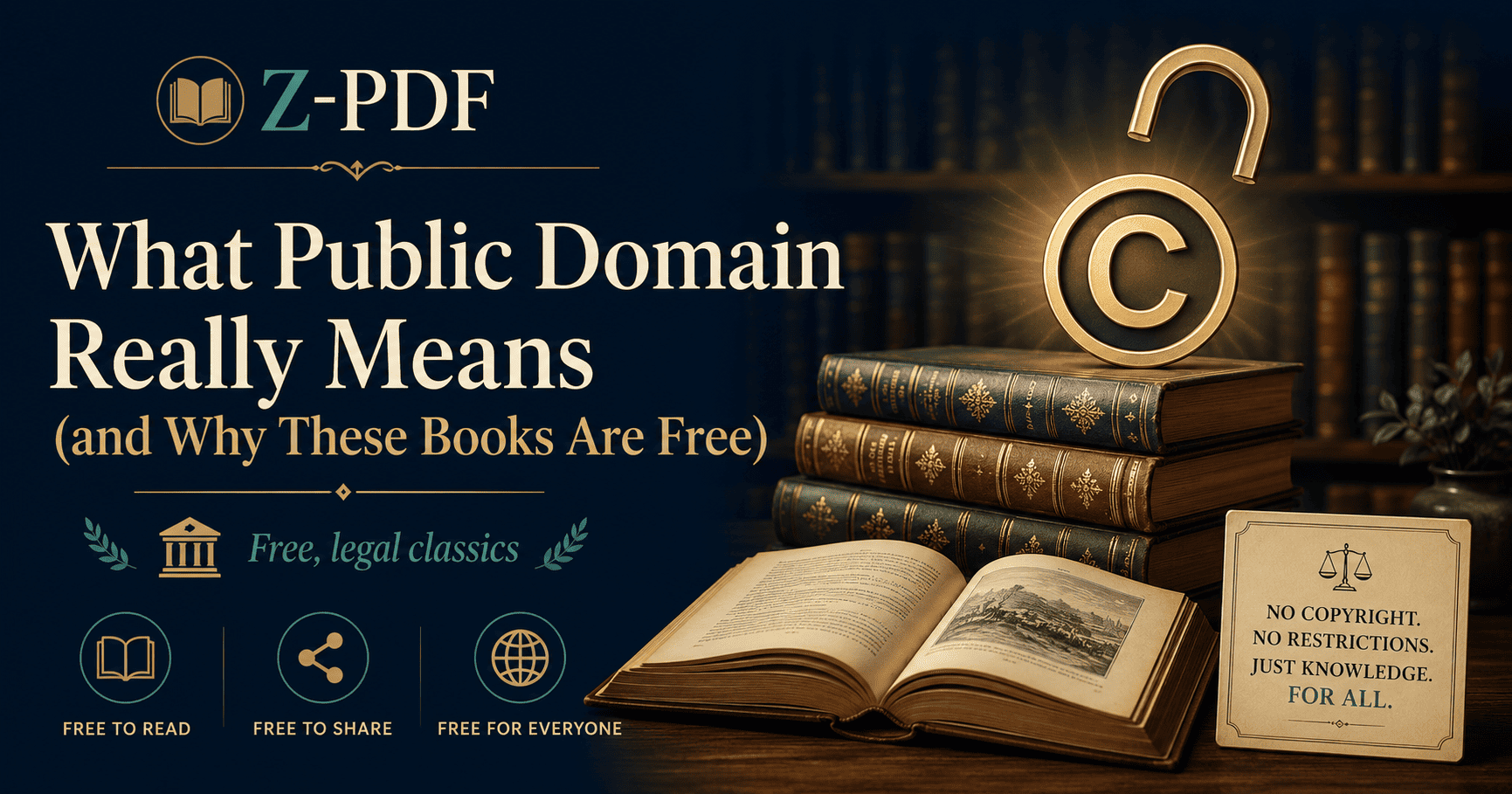
Every book on Z-PDF is free to download, and all of it is completely legal. The reason is a piece of copyright law with an unglamorous name and a genuinely wonderful effect: the public domain. Here is what it actually means, why so many great books belong to it, and how to know a work is truly free to use.
What the public domain is
Copyright gives an author, and later their heirs or publishers, exclusive rights over a work for a limited time. When that time runs out, the work enters the public domain, which means no one owns it any longer. Anyone can read it, copy it, translate it, adapt it, or give it away without asking permission or paying a fee. It becomes, in the truest sense, part of our shared cultural inheritance.
Why so many classics are free
Copyright terms are long, but not endless. In the United States, virtually every work published before 1929 is now in the public domain, and a fresh year of works joins the commons every January the first, a date enthusiasts call Public Domain Day. Many other countries use a different rule: the life of the author plus seventy years, which frees a work a set time after the writer's death. The practical result is the same. The great literature of the nineteenth and early twentieth centuries now belongs to everyone.
Free to read is not the same as public domain
These two ideas are easy to confuse. A book can be free to read on a website while still being under copyright; the site simply holds a licence. A public-domain book, by contrast, is free to everyone, for any purpose, permanently. It is the difference between borrowing and owning outright. This is exactly why public-domain texts can appear across countless libraries, apps, and editions without anyone breaking the law.
The modern cousin: open licences
Not everything free is old. Some contemporary authors deliberately release their work under open licences such as Creative Commons, keeping their copyright but granting broad permission to share. Careful projects like Standard Ebooks also produce beautifully typeset, meticulously proofread editions of public-domain texts and release them freely. Z-PDF draws on both streams: long-established public-domain classics and openly licensed modern editions.
How to tell a book is genuinely free
A few reliable signals help. The author died more than seventy years ago. The work was first published before the public-domain cutoff for your country. Or it carries a clear open-licence notice. Reputable sources such as national libraries, Project Gutenberg, and Standard Ebooks do this verification for you, which is why Z-PDF sources its catalogue from them rather than from anonymous uploads. Copyright status can still vary from country to country, so if you plan to reuse a work commercially, it is worth a quick check for your own jurisdiction.
Why it matters
The public domain is not a loophole; it is the entire point of the system. Copyright was always meant to be a temporary bargain, a limited monopoly granted in exchange for eventually enriching the commons. Every book that enters the public domain is that bargain paying off. So when you download a free classic here, you are not getting away with anything. You are collecting your share of a cultural dividend that took a century to mature.
Start exploring
Ready to put the idea to use? Browse the full Z-PDF library or explore by category and author. Every title you find is yours to read, keep, and share.