
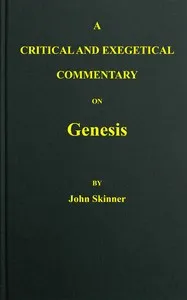
A critical and exegetical commentary on Genesis
by John Skinner
- Language
- EN
- Format
- EPUB
- Size
- 1.6 MB
Description
"A critical and exegetical commentary on Genesis" by John Skinner is a scholarly biblical commentary written in the early 20th century. It offers a rigorous, historically informed reading of Genesis, combining philology, source criticism, and comparative Ancient Near Eastern studies to clarify the book’s origins, structure, and theology. Skinner frames Genesis as a collection of Hebrew origins shaped by legend and myth, then tests and interprets those traditions against linguistic evidence, archaeology, and literary analysis.
The opening of this volume presents the International Critical Commentary’s aims—international, interconfessional, and strictly critical—outlining methods, audience, and layout. Skinner’s preface surveys earlier English and German work, acknowledges deep indebtedness to Gunkel, affirms the documentary hypothesis (J, E, P), downplays old science-versus-Bible debates, and argues that Genesis preserves legends and myths refined by Israel’s faith; archaeology may corroborate elements, but the narratives retain a legendary atmosphere. His introduction situates Genesis within the Torah and contrasts its family narratives with the national history that begins in Exodus; explains the title; and then asks whether Genesis is history or legend, concluding that its oral transmission, duplicated stories, domestic “folk-tale” focus, and factual improbabilities mark it as legendary while still religiously true. He traces foreign mythic influences (especially Babylonian for creation and flood) and classifies key motives: etiological explanations, ethnographic personifications of peoples, cult-legends for sanctuaries and rites, playful name etymologies, and poetic idealization. Finally, he sketches the possible historical backdrop (roughly the early–mid second millennium BC), reviews evidence from Sinuhe, the Amarna letters, and inscriptions (e.g., Jakob-el, Israel), and cautions that such data illuminate the setting without proving the patriarchs’ biographies—an argument the introduction leaves midstream as the excerpt ends.
The opening of this volume presents the International Critical Commentary’s aims—international, interconfessional, and strictly critical—outlining methods, audience, and layout. Skinner’s preface surveys earlier English and German work, acknowledges deep indebtedness to Gunkel, affirms the documentary hypothesis (J, E, P), downplays old science-versus-Bible debates, and argues that Genesis preserves legends and myths refined by Israel’s faith; archaeology may corroborate elements, but the narratives retain a legendary atmosphere. His introduction situates Genesis within the Torah and contrasts its family narratives with the national history that begins in Exodus; explains the title; and then asks whether Genesis is history or legend, concluding that its oral transmission, duplicated stories, domestic “folk-tale” focus, and factual improbabilities mark it as legendary while still religiously true. He traces foreign mythic influences (especially Babylonian for creation and flood) and classifies key motives: etiological explanations, ethnographic personifications of peoples, cult-legends for sanctuaries and rites, playful name etymologies, and poetic idealization. Finally, he sketches the possible historical backdrop (roughly the early–mid second millennium BC), reviews evidence from Sinuhe, the Amarna letters, and inscriptions (e.g., Jakob-el, Israel), and cautions that such data illuminate the setting without proving the patriarchs’ biographies—an argument the introduction leaves midstream as the excerpt ends.
Ask about this book
An AI guide answers your questions about this title
FAQ
Is "A critical and exegetical commentary on Genesis" free to download?
Yes, it is free to download — no sign up needed.
What format is the file?
EPUB.
More by John Skinner

Reader reviews Be the first
No reviews yet. Be the first to review this book.
Write a review
Protected by reCAPTCHA.