
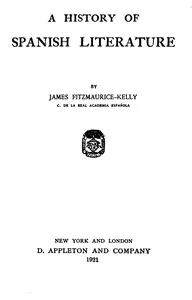
A History of Spanish Literature
- Language
- EN
- Format
- EPUB
- Size
- 453 KB
Description
A history of Spanish literature traces the development of literary expression within the territory of Spain from its Roman origins through the early 20th century. The work examines the evolution of literary forms and themes, with particular emphasis on the contributions of the Castilian language and culture. It discusses the influence of various historical periods, including the Silver Age, on literary production, and considers the impact of external cultures and languages on Spain’s literary history. The book provides a chronological account that situates significant authors, texts, and movements within their broader historical context, illustrating how political and social changes shaped literary trends over time. As a scholarly work, it aims to offer an authoritative overview suitable for students and historians interested in the cultural history of Spain.
The work was published in 1921 and is part of a series on world literatures, reflecting early 20th-century scholarly perspectives on national literary histories.
The work was published in 1921 and is part of a series on world literatures, reflecting early 20th-century scholarly perspectives on national literary histories.
From the opening pages
Obvious punctuation errors and misprints have been corrected. Blank pages present in the printed original have been deleted in the e-text version. Short Histories of the Literatures of the World Edited by Edmund Gosse A HISTORY OF SPANISH LITERATURE BY JAMES FITZMAURICE-KELLY C. DE LA REAL ACADEMIA ESPAÑOLA NEW YORK AND LONDON D. APPLETON AND COMPANY 1921 Copyright, 1898, By D. APPLETON AND COMPANY. Printed in the United States of America PREFACE Spanish literature, in its broadest sense, might include writings in every tongue existing within the Spanish dominions; it might, at all events, include the four chief languages of Spain. Asturian and Galician both possess literatures which in their recent developments are artificial. Basque, the spoiled child of philologers, has not added greatly to the sum of the world's delight; and even if it had, I should be incapable of undertaking a task which would belong of right to experts like Mr. Wentworth Webster, M. Jules Vinson, and Professor Schuchardt. Catalan is so singularly rich and varied that it might well deserve separate treatment: its inclusion here would be as unjustifiable as the inclusion of Provençal in a work dealing with French literature. For the purposes of this book, minor varieties are neglected, and Spanish literature is taken as referring solely to Castilian—the speech of Juan Ruiz, Cervantes, Lope de Vega, Tirso de Molina, Quevedo, and Calderón. At the close of the last century, Nicolas Masson de Morvilliers raised a hubbub by asking two questions in the Encyclopédie Méthodique :—"Mais que doit-on l'Espagne? Et depuis deux siècles, depuis quatre, depuis six, qu'a-t elle fait pour l'Europe?" I have attempted an answer in this volume. The introductory chapter has been written to remind readers that the great figures of the Silver Age—Seneca, Lucan, Martial, Quintilian—were Spaniards as well as Romans. It further aims at tracing the stream of literature from its Roman fount to the channels of the Gothic period; at defining the limits of Arabic and Hebrew influence on Spanish letters; at refuting the theory which assumes the existence of immemorial romances , and at explaining the interaction between Spanish on the one side and Provençal and French on the other. It has been thought that this treatment saves much digression. Spanish literature, like our own, takes its root in French and in Italian soil; in the anonymous epics, in the fableaux , as in Dante, Petrarch, and…
Ask about this book
An AI guide answers your questions about this title
FAQ
Is "A History of Spanish Literature" free to download?
Yes, it is free to download — no sign up needed.
What format is the file?
EPUB.
More by James Fitzmaurice-Kelly

Similar books



Reader reviews Be the first
No reviews yet. Be the first to review this book.
Write a review
Protected by reCAPTCHA.