
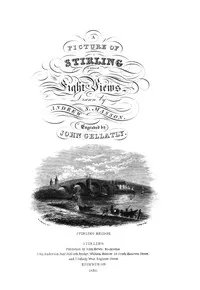
A picture of Stirling: a series of eight views
- Language
- EN
- Format
- EPUB
- Size
- 2.4 MB
Description
"A picture of Stirling" by Robert Chambers is an illustrated topographical and historical account written in the early 19th century. Focused on the town of Stirling and its commanding castle—the “Key of the Highlands”—it pairs scenic plates with concise essays on geography, architecture, antiquities, and memorable events. The volume is aimed at travelers and history‑minded readers who want a vivid sense of place and past.
The opening of this volume introduces the project’s engraved views and launches a brisk “General Account” of Stirling: its site on the Forth, strategic control of the central Scottish isthmus, traces of Roman presence, early status as a royal burgh, growth alongside the castle, and a townscape likened to a smaller Edinburgh. It sketches civic governance, courts, churches, and a noted religious seriousness, with a nod to Ebenezer Erskine’s secession. A substantial section on the castle blends history—from medieval wars and the Stuart court to Cromwellian and Jacobite episodes—with a tour of its approaches, batteries, the Ballangeich lore of James V, the sculptured palace fronts, rescued carved oaken portraits, the Douglas Room tradition, the Parliament House, and James VI’s chapel raised for a princely baptism. The environs follow: the desolate but traceable King’s Gardens (with the “King’s Knote” and “Round Table”), the King’s Park, the Mote-hill (justice mound, executions, and boyhood “hurly” tales), the Valley and Ladies’ Hill for tournaments, and the celebrated public walks with sweeping Highland‑to‑Lowland panoramas. The churches section distinguishes the West (Franciscan) and East (Cardinal Beaton’s chancel), marking milestones such as Arran’s abjuration and the coronation of James VI, and notes Cowan’s Hospital. A view of Broad Street recalls its noble townhouses, the lost market cross, the daring raid that seized the regent Lennox, and the ornate “Mar’s Work,” while Castle Wynd centers on Argyll’s Lodging (built by the future Earl of Stirling) and a fatal skirmish. It closes with Stirling Bridge—its medieval wooden predecessor tied to Wallace’s victory, the antique stone bridge later altered in wartime—and points ahead to notes on royal visits, the famed Stirling Pint, and other antiquarian details.
The opening of this volume introduces the project’s engraved views and launches a brisk “General Account” of Stirling: its site on the Forth, strategic control of the central Scottish isthmus, traces of Roman presence, early status as a royal burgh, growth alongside the castle, and a townscape likened to a smaller Edinburgh. It sketches civic governance, courts, churches, and a noted religious seriousness, with a nod to Ebenezer Erskine’s secession. A substantial section on the castle blends history—from medieval wars and the Stuart court to Cromwellian and Jacobite episodes—with a tour of its approaches, batteries, the Ballangeich lore of James V, the sculptured palace fronts, rescued carved oaken portraits, the Douglas Room tradition, the Parliament House, and James VI’s chapel raised for a princely baptism. The environs follow: the desolate but traceable King’s Gardens (with the “King’s Knote” and “Round Table”), the King’s Park, the Mote-hill (justice mound, executions, and boyhood “hurly” tales), the Valley and Ladies’ Hill for tournaments, and the celebrated public walks with sweeping Highland‑to‑Lowland panoramas. The churches section distinguishes the West (Franciscan) and East (Cardinal Beaton’s chancel), marking milestones such as Arran’s abjuration and the coronation of James VI, and notes Cowan’s Hospital. A view of Broad Street recalls its noble townhouses, the lost market cross, the daring raid that seized the regent Lennox, and the ornate “Mar’s Work,” while Castle Wynd centers on Argyll’s Lodging (built by the future Earl of Stirling) and a fatal skirmish. It closes with Stirling Bridge—its medieval wooden predecessor tied to Wallace’s victory, the antique stone bridge later altered in wartime—and points ahead to notes on royal visits, the famed Stirling Pint, and other antiquarian details.
Ask about this book
An AI guide answers your questions about this title
FAQ
Is "A picture of Stirling: a series of eight views" free to download?
Yes, it is free to download — no sign up needed.
What format is the file?
EPUB.
More by Robert Chambers

Reader reviews Be the first
No reviews yet. Be the first to review this book.
Write a review
Protected by reCAPTCHA.