
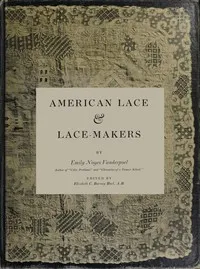
American lace & lace-makers
- Language
- EN
- Format
- EPUB
- Size
- 19 MB
Description
American lace & lace-makers by Emily Noyes Vanderpoel is an illustrated historical survey written in the early 20th century. It examines the origins, techniques, and cultural life of lace-making in the Americas, from indigenous fibers and ancient Peruvian work to colonial and 19th‑century handmade and machine-aided lace. The work pairs concise historical commentary with a substantial catalog of plates documenting patterns, tools, and finished pieces from museums and family collections.
The opening of the volume presents acknowledgments, a list of plates, and an introduction that argues lace is best understood through images, then defines the main handmade types (needle-point and pillow/bobbin) and notes an indigenous “third kind” from Jamaica’s lace-bark tree. It traces early American lace to ancient Peruvian textiles and to Native makers (Papago, Hopi, Balienti), highlights Sybil Carter’s training of U.S. Indian communities, and turns to colonial New England where Ipswich women produced pillow lace. The narrative explains the rise of machine-made net and the spread of Limerick-style darned and tambour work, including a detailed case of Medway, Massachusetts, where entrepreneurs built lace machines and local women embroidered the net. To show the social setting, it quotes ads, school manuals, and diaries from academies such as Miss Pierce’s in Litchfield, depicting rigorous study, moral discipline, and skilled needlework as part of women’s education. It stresses that American lace was largely domestic rather than commercial, shaped by limited amusements and a strong craft ethos. The section closes by asserting that the following plates demonstrate the high artistic level achieved by American lace-makers. (This is an automatically generated summary.)
The opening of the volume presents acknowledgments, a list of plates, and an introduction that argues lace is best understood through images, then defines the main handmade types (needle-point and pillow/bobbin) and notes an indigenous “third kind” from Jamaica’s lace-bark tree. It traces early American lace to ancient Peruvian textiles and to Native makers (Papago, Hopi, Balienti), highlights Sybil Carter’s training of U.S. Indian communities, and turns to colonial New England where Ipswich women produced pillow lace. The narrative explains the rise of machine-made net and the spread of Limerick-style darned and tambour work, including a detailed case of Medway, Massachusetts, where entrepreneurs built lace machines and local women embroidered the net. To show the social setting, it quotes ads, school manuals, and diaries from academies such as Miss Pierce’s in Litchfield, depicting rigorous study, moral discipline, and skilled needlework as part of women’s education. It stresses that American lace was largely domestic rather than commercial, shaped by limited amusements and a strong craft ethos. The section closes by asserting that the following plates demonstrate the high artistic level achieved by American lace-makers. (This is an automatically generated summary.)
FAQ
Is "American lace & lace-makers" free to download?
Yes, it is free to download — no sign up needed.
What format is the file?
EPUB.
More by Emily Noyes Vanderpoel

Reader reviews Be the first
No reviews yet. Be the first to review this book.
Write a review
Protected by reCAPTCHA.