
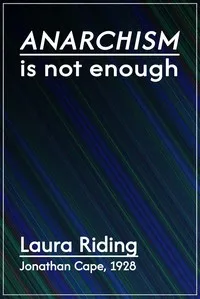
Anarchism is not enough
by Laura Riding
- Language
- EN
- Format
- EPUB
- Size
- 364 KB
Description
"Anarchism is not enough" by Laura Riding is a collection of critical essays written in the early 20th century. It examines social myth, language, and the arts to argue for a radically anti-social conception of poetry that refuses systems, utility, and cultural consolations. The work’s stance is aphoristic and polemical, recasting poetry as a stubborn “nothing” set against the world’s organizing myths.
The opening of the book dismantles “the Myth,” a collective pretense of permanence, and sets poetry against it as the art of “not living,” permanently ephemeral and resistant to duty. It calls language a form of laziness, treats prose as mere calculation, and defines a poem as a vacuum that criticism keeps trying to fill with “something.” Short sections skewer simplification, literary precocity, and gentlemanly idealism, while a satire (“Mr. Doodle-Doodle-Doo”) mocks pedantic word-mathematics. A theory of the social “Corpus” opposes the individual mind to group mind, then contrasts poetry with music, painting, and dreams to defend poetry’s isolating, non-tribal energy. A long polemic (“Jocasta”) critiques Spengler’s collective-real and Wyndham Lewis’s individual-real, insisting both remain forms of realism that crowd out the truly unreal; it contrasts Defoe’s liberating inconsistency with the “slick” metaphorical realism of writers like Virginia Woolf and E. M. Forster. The opening closes by separating poetry from literature and systems, and by using brief engagements with figures such as Herbert Read, T. S. Eliot, Roger Fry, and I. A. Richards to show how criticism and philosophy convert the unreal into respectable reality.
The opening of the book dismantles “the Myth,” a collective pretense of permanence, and sets poetry against it as the art of “not living,” permanently ephemeral and resistant to duty. It calls language a form of laziness, treats prose as mere calculation, and defines a poem as a vacuum that criticism keeps trying to fill with “something.” Short sections skewer simplification, literary precocity, and gentlemanly idealism, while a satire (“Mr. Doodle-Doodle-Doo”) mocks pedantic word-mathematics. A theory of the social “Corpus” opposes the individual mind to group mind, then contrasts poetry with music, painting, and dreams to defend poetry’s isolating, non-tribal energy. A long polemic (“Jocasta”) critiques Spengler’s collective-real and Wyndham Lewis’s individual-real, insisting both remain forms of realism that crowd out the truly unreal; it contrasts Defoe’s liberating inconsistency with the “slick” metaphorical realism of writers like Virginia Woolf and E. M. Forster. The opening closes by separating poetry from literature and systems, and by using brief engagements with figures such as Herbert Read, T. S. Eliot, Roger Fry, and I. A. Richards to show how criticism and philosophy convert the unreal into respectable reality.
Ask about this book
An AI guide answers your questions about this title
FAQ
Is "Anarchism is not enough" free to download?
Yes, it is free to download — no sign up needed.
What format is the file?
EPUB.
Reader reviews Be the first
No reviews yet. Be the first to review this book.
Write a review
Protected by reCAPTCHA.