
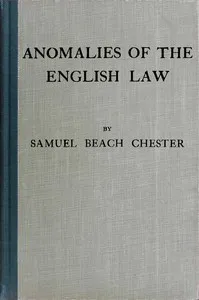
Anomalies of the English law
by S. Beach (Samuel Beach) Chester
- Language
- EN
- Format
- EPUB
- Size
- 513 KB
Description
"Anomalies of the English law" by S. Beach Chester is a legal commentary written in the early 20th century. It surveys contradictions and inequities across English law and urges humane, common‑sense reforms, using vivid cases and comparisons with Scottish, French, and Roman law. The focus is on how rigid formalities and costly, centralised procedures injure ordinary people and how targeted changes could make justice simpler, fairer, and cheaper.
The opening of this work frames the project with a lively satire on barristers’ omniscience, then launches into a reformist critique of divorce: it condemns combining Probate, Divorce, and Admiralty under one judge, calls for abolishing judicial separation and the decree nisi delay, allowing divorce after a year’s separation (including mutual adultery cases), and extending cheap, local access via County Courts—arguments illustrated by hard cases (a compassionate decree to a “fallen” wife, a Norwich compensation dispute between two putative widows, a fabricated confession, and the futility of “restitution of conjugal rights”). It next examines death and burial through a proposed Coroners’ Bill—professionalising coroners, adding pathologists, permitting inquiries without full inquests, tightening records, and, crucially, requiring certification of the fact as well as cause of death—while warning against premature burial, critiquing French grave leases and funeral monopolies, and urging oversight of exploitative undertakers. A chapter on wills stresses strict execution formalities (two witnesses present, marriage revocation), shows how tiny defects can defeat clear intent (a dying mother unable to sign; a later holograph will fought on witnessing technicalities), and notes that one cannot profit from crime (the Crippen probate ruling). On libel and slander, it concisely defines what is actionable, outlines publication and criminal aspects (sedition, obscenity), recounts the Mylius libel on the King and the court’s response, and suggests hearing some cases in camera to avoid compounding harm. The text then begins to challenge imprisonment for debt and the perverse dynamics of credit before the excerpt ends.
The opening of this work frames the project with a lively satire on barristers’ omniscience, then launches into a reformist critique of divorce: it condemns combining Probate, Divorce, and Admiralty under one judge, calls for abolishing judicial separation and the decree nisi delay, allowing divorce after a year’s separation (including mutual adultery cases), and extending cheap, local access via County Courts—arguments illustrated by hard cases (a compassionate decree to a “fallen” wife, a Norwich compensation dispute between two putative widows, a fabricated confession, and the futility of “restitution of conjugal rights”). It next examines death and burial through a proposed Coroners’ Bill—professionalising coroners, adding pathologists, permitting inquiries without full inquests, tightening records, and, crucially, requiring certification of the fact as well as cause of death—while warning against premature burial, critiquing French grave leases and funeral monopolies, and urging oversight of exploitative undertakers. A chapter on wills stresses strict execution formalities (two witnesses present, marriage revocation), shows how tiny defects can defeat clear intent (a dying mother unable to sign; a later holograph will fought on witnessing technicalities), and notes that one cannot profit from crime (the Crippen probate ruling). On libel and slander, it concisely defines what is actionable, outlines publication and criminal aspects (sedition, obscenity), recounts the Mylius libel on the King and the court’s response, and suggests hearing some cases in camera to avoid compounding harm. The text then begins to challenge imprisonment for debt and the perverse dynamics of credit before the excerpt ends.
Ask about this book
An AI guide answers your questions about this title
FAQ
Is "Anomalies of the English law" free to download?
Yes, it is free to download — no sign up needed.
What format is the file?
EPUB.
Similar books
Reader reviews Be the first
No reviews yet. Be the first to review this book.
Write a review
Protected by reCAPTCHA.