
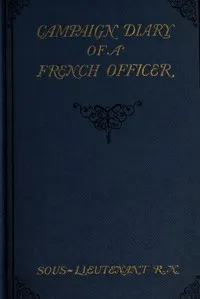
Campaign diary of a French officer
- Language
- EN
- Format
- EPUB
- Size
- 353 KB
Description
"Campaign diary of a French officer" by Lieutenant René Nicolas is a firsthand war diary written in the early 20th century. It chronicles a young French officer’s World War I service on the Western Front, focusing on trench life, marches, bombardments, small‑unit actions, and the emotional and physical toll on soldiers. Drawn from field notes rather than polished prose, it covers several months in 1915 in Champagne and Artois with vivid, matter‑of‑fact immediacy.
The opening of the diary presents a friend’s preface describing the blood‑stained, mud‑smeared notebook and sketching the author’s path from elite student to junior officer, his early months in Champagne, a spring crossing of Argonne, and the lead‑up to the Artois offensive, noting he is later seriously wounded; a foreword by the author explains how soldiers keep pocket journals, his intent to write objectively, and why American interest prompted publication. The narrative then follows his eager departure for the front, first billets among kind peasants near La Cheppe and Suippes, and the ceaseless rumble of guns and convoys. He reaches the trenches by night through mud‑choked communication lines, describes dugouts, sentry routines, and a feint: a timed four‑minute rifle and machine‑gun burst supporting a larger attack elsewhere, which draws a heavy German bombardment and a repelled assault at 150 meters. Brief rest alternates with return to the line; he repairs wire under fire, accepts a Bavarian deserter who provides useful intelligence, and moves to second line. A harrowing sequence follows: endless mud, corpse‑strewn captured works, enfilade fire, night digging, filthy rations, and then a sudden German attack that he counters with grenades and a short charge, seizing the trench, reversing its defenses, and holding under shelling. Exhausted, he rotates rearward, then back again, recounts a solemn parade before the regimental flag, quiet days in fourth‑line encampment with fatigue duties and a night burial detail blessed by a priest, a visit to a 75‑mm battery, and his promotion. The provided pages end as he returns to a perilous sector where French and German first lines are separated only by a sandbag barricade, grenades fly constantly, and the shallow trench, hardened over buried bodies, forces men to move bent double.
The opening of the diary presents a friend’s preface describing the blood‑stained, mud‑smeared notebook and sketching the author’s path from elite student to junior officer, his early months in Champagne, a spring crossing of Argonne, and the lead‑up to the Artois offensive, noting he is later seriously wounded; a foreword by the author explains how soldiers keep pocket journals, his intent to write objectively, and why American interest prompted publication. The narrative then follows his eager departure for the front, first billets among kind peasants near La Cheppe and Suippes, and the ceaseless rumble of guns and convoys. He reaches the trenches by night through mud‑choked communication lines, describes dugouts, sentry routines, and a feint: a timed four‑minute rifle and machine‑gun burst supporting a larger attack elsewhere, which draws a heavy German bombardment and a repelled assault at 150 meters. Brief rest alternates with return to the line; he repairs wire under fire, accepts a Bavarian deserter who provides useful intelligence, and moves to second line. A harrowing sequence follows: endless mud, corpse‑strewn captured works, enfilade fire, night digging, filthy rations, and then a sudden German attack that he counters with grenades and a short charge, seizing the trench, reversing its defenses, and holding under shelling. Exhausted, he rotates rearward, then back again, recounts a solemn parade before the regimental flag, quiet days in fourth‑line encampment with fatigue duties and a night burial detail blessed by a priest, a visit to a 75‑mm battery, and his promotion. The provided pages end as he returns to a perilous sector where French and German first lines are separated only by a sandbag barricade, grenades fly constantly, and the shallow trench, hardened over buried bodies, forces men to move bent double.
Ask about this book
An AI guide answers your questions about this title
FAQ
Is "Campaign diary of a French officer" free to download?
Yes, it is free to download — no sign up needed.
What format is the file?
EPUB.
Reader reviews Be the first
No reviews yet. Be the first to review this book.
Write a review
Protected by reCAPTCHA.