
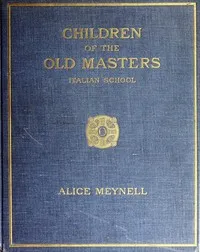
Children of the old masters (Italian school)
- Language
- EN
- Format
- EPUB
- Size
- 11 MB
Description
"Children of the old masters (Italian school)" by Alice Meynell is an art-historical essay collection written in the early 20th century. It explores how Italian artists—from early Christian and Byzantine inheritances through the Renaissance and beyond—imagined children, chiefly the Christ Child, putti, the young St. John, and, later, secular portraits. Meynell weighs devotion, convention, and style against truthful observation, noting how sculptors and painters alternately idealized, stylized, or freshly observed the child figure.
The opening of the book contrasts older image-making as homage with modern mockery, then shows how European art centered for centuries on the Madonna and Child, often treating Christ’s infancy as an eternal mystery. Meynell observes that many Bambini were rendered as corpulent, adult-gestured “fine” children, with rare but luminous exceptions (notably the Della Robbias, occasional Botticellis, and some Titians), and that girl-children scarcely appear. She traces the thread from the lively Catacomb Child and Byzantine mosaics to Cimabue, Duccio, Giotto, and the Nativity seen more as mystery than event. Sculpture leads with naturalism—Giovanni Pisano, Donatello, Jacopo della Quercia, and especially Luca and Andrea della Robbia—while Michelangelo’s infants are judged unchildlike. Among painters, Fra Angelico’s dolls, Masaccio’s and Fra Filippo’s mixed naturalism, Benozzo’s vivid schoolboys, and Botticelli’s devotional-decorative Bambini give way to Ghirlandajo’s putti and his tender “Old Man and Child,” Leonardo’s angelic heads and child studies, Filippino and Lorenzo di Credi’s adolescent angels, and a fashion for infant musicians (Rosso, Fra Bartolommeo). The section then turns to portraits: Bronzino’s named children restore directness, Pontormo slips in scrappy street boys, Mantegna dignifies Gonzaga heirs, and in Venice Titian and followers (Paris Bordone, Tiberio Titi) paint princelings and tender youngsters—leading into Barocci as the text breaks.
The opening of the book contrasts older image-making as homage with modern mockery, then shows how European art centered for centuries on the Madonna and Child, often treating Christ’s infancy as an eternal mystery. Meynell observes that many Bambini were rendered as corpulent, adult-gestured “fine” children, with rare but luminous exceptions (notably the Della Robbias, occasional Botticellis, and some Titians), and that girl-children scarcely appear. She traces the thread from the lively Catacomb Child and Byzantine mosaics to Cimabue, Duccio, Giotto, and the Nativity seen more as mystery than event. Sculpture leads with naturalism—Giovanni Pisano, Donatello, Jacopo della Quercia, and especially Luca and Andrea della Robbia—while Michelangelo’s infants are judged unchildlike. Among painters, Fra Angelico’s dolls, Masaccio’s and Fra Filippo’s mixed naturalism, Benozzo’s vivid schoolboys, and Botticelli’s devotional-decorative Bambini give way to Ghirlandajo’s putti and his tender “Old Man and Child,” Leonardo’s angelic heads and child studies, Filippino and Lorenzo di Credi’s adolescent angels, and a fashion for infant musicians (Rosso, Fra Bartolommeo). The section then turns to portraits: Bronzino’s named children restore directness, Pontormo slips in scrappy street boys, Mantegna dignifies Gonzaga heirs, and in Venice Titian and followers (Paris Bordone, Tiberio Titi) paint princelings and tender youngsters—leading into Barocci as the text breaks.
Ask about this book
An AI guide answers your questions about this title
FAQ
Is "Children of the old masters (Italian school)" free to download?
Yes, it is free to download — no sign up needed.
What format is the file?
EPUB.
More by Alice Meynell




Reader reviews Be the first
No reviews yet. Be the first to review this book.
Write a review
Protected by reCAPTCHA.