
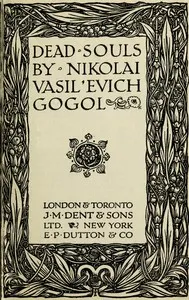
Dead Souls
- Language
- EN
- Format
- EPUB
- Size
- 604 KB
Description
This novel is a satirical prose narrative structured around a series of episodes involving the character Pavel Ivanovich Chichikov. It is set in a provincial Russian town during the 19th century and critically examines the social and moral state of Russia's middle aristocracy through exaggerated caricatures and humorous scenarios. The work employs a episodic format, combining dialogue, character sketches, and narrative commentary to expose issues of greed, corruption, and pretension prevalent among landowners and officials.
Published in 1842, "Dead Souls" is considered an important work of Russian literature and reflects the social dynamics of its period. Though it remains incomplete, the novel’s sharp satire and vivid characterisations have secure its place within the canon of 19th-century realist fiction. The narrative combines elements of comedy and critique to offer a pointed depiction of Russian society prior to major reforms.
Published in 1842, "Dead Souls" is considered an important work of Russian literature and reflects the social dynamics of its period. Though it remains incomplete, the novel’s sharp satire and vivid characterisations have secure its place within the canon of 19th-century realist fiction. The narrative combines elements of comedy and critique to offer a pointed depiction of Russian society prior to major reforms.
From the opening pages
Nikolai Vasilievich Gogol, born at Sorochintsky, Russia, on 31st March 1809. Obtained government post at St. Petersburg and later an appointment at the university. Lived in Rome from 1836 to 1848. Died on 21st February 1852. PREPARER’S NOTE The book this was typed from contains a complete Part I, and a partial Part II, as it seems only part of Part II survived the adventures described in the introduction. Where the text notes that pages are missing from the “original”, this refers to the Russian original, not the translation. All the foreign words were italicised in the original, a style not preserved here. Accents and diphthongs have also been left out. INTRODUCTION Dead Souls, first published in 1842, is the great prose classic of Russia. That amazing institution, “the Russian novel,” not only began its career with this unfinished masterpiece by Nikolai Vasil’evich Gogol, but practically all the Russian masterpieces that have come since have grown out of it, like the limbs of a single tree. Dostoieffsky goes so far as to bestow this tribute upon an earlier work by the same author, a short story entitled The Cloak; this idea has been wittily expressed by another compatriot, who says: “We have all issued out of Gogol’s Cloak.” Dead Souls, which bears the word “Poem” upon the title page of the original, has been generally compared to Don Quixote and to the Pickwick Papers, while E. M. Vogue places its author somewhere between Cervantes and Le Sage. However considerable the influences of Cervantes and Dickens may have been—the first in the matter of structure, the other in background, humour, and detail of characterisation—the predominating and distinguishing quality of the work is undeniably something foreign to both and quite peculiar to itself; something which, for want of a better term, might be called the quality of the Russian soul. The English reader familiar with the works of Dostoieffsky, Turgenev, and Tolstoi, need hardly be told what this implies; it might be defined in the words of the French critic just named as “a tendency to pity.” One might indeed go further and say that it implies a certain tolerance of one’s characters even though they be, in the conventional sense, knaves, products, as the case might be, of conditions or circumstance, which after all is the thing to be criticised and not the man. But pity and tolerance are rare in
Ask about this book
An AI guide answers your questions about this title
FAQ
Is "Dead Souls" free to download?
Yes, it is free to download — no sign up needed.
What format is the file?
EPUB.
More by Nikolai Vasilevich Gogol

![Home Life in Russia, Volumes 1 and 2: [Dead Souls] — Nikolai Vasilevich Gogol cover](https://z-pdf.com/img-cache/400/covers/gutenberg/2026/07/pg58070.jpg.webp)

Similar books


Reader reviews Be the first
No reviews yet. Be the first to review this book.
Write a review
Protected by reCAPTCHA.