
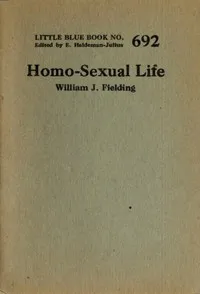
Homo-sexual life
by William J. (William John) Fielding
- Language
- EN
- Format
- EPUB
- Size
- 291 KB
Description
Homo-sexual life by William J. Fielding is a popular sexology and psychological treatise written in the early 20th century. It examines homosexuality within human development and culture, presenting it as a complex blend of biology, psychology, and social influence, and argues for understanding the topic beyond stigma.
The book opens with the idea that sexual development typically passes from self-focused impulses to same-sex attachments and finally to heterosexuality, with bisexual traits present in everyone; it illustrates this with biological analogies and childhood patterns of friendship and sublimation. It then surveys competing explanations: hereditary and masturbation-based theories (criticized), views of inborn inversion, chemical and constitutional hypotheses, and psychoanalytic accounts (Freud, Adler, Sadger, Stekel) that stress fixation, identification, and neurosis, alongside Ulrichs’ classic classifications. A wide cultural history follows—Greek pederasty and Sappho, bisexual deities, Roman excess and later repression, and roles akin to “third genders” in Indigenous and Asian contexts—plus a roster of notable figures with homosexual or bisexual temperaments. Turning to pathology, Fielding summarizes Freud’s claim that “perversions” underlie many neuroses, details erogenous zones and symptom formation, and presents Kempf’s “acute homosexual panic” in segregated settings, while challenging blanket “degeneracy” labels. He concludes with Edward Carpenter’s “Intermediate Sex,” emphasizing the positive endowments often seen in inverts—emotional depth, philanthropy, artistic aptitude, strong friendships (including with women), and practical ability—arguing that their attachments are not necessarily sexual and that they can serve as interpreters between the sexes. (This is an automatically generated summary.)
The book opens with the idea that sexual development typically passes from self-focused impulses to same-sex attachments and finally to heterosexuality, with bisexual traits present in everyone; it illustrates this with biological analogies and childhood patterns of friendship and sublimation. It then surveys competing explanations: hereditary and masturbation-based theories (criticized), views of inborn inversion, chemical and constitutional hypotheses, and psychoanalytic accounts (Freud, Adler, Sadger, Stekel) that stress fixation, identification, and neurosis, alongside Ulrichs’ classic classifications. A wide cultural history follows—Greek pederasty and Sappho, bisexual deities, Roman excess and later repression, and roles akin to “third genders” in Indigenous and Asian contexts—plus a roster of notable figures with homosexual or bisexual temperaments. Turning to pathology, Fielding summarizes Freud’s claim that “perversions” underlie many neuroses, details erogenous zones and symptom formation, and presents Kempf’s “acute homosexual panic” in segregated settings, while challenging blanket “degeneracy” labels. He concludes with Edward Carpenter’s “Intermediate Sex,” emphasizing the positive endowments often seen in inverts—emotional depth, philanthropy, artistic aptitude, strong friendships (including with women), and practical ability—arguing that their attachments are not necessarily sexual and that they can serve as interpreters between the sexes. (This is an automatically generated summary.)
FAQ
Is "Homo-sexual life" free to download?
Yes, it is free to download — no sign up needed.
What format is the file?
EPUB.
More by William J. (William John) Fielding
Reader reviews Be the first
No reviews yet. Be the first to review this book.
Write a review
Protected by reCAPTCHA.