
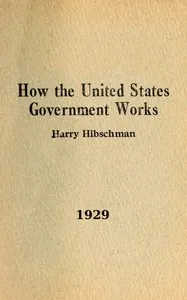
How the United States government works
- Language
- EN
- Format
- EPUB
- Size
- 321 KB
Description
How the United States government works by Harry Hibschman is a concise civics primer written in the early 20th century. It outlines the structure and operation of the U.S. federal system with an emphasis on separation of powers, checks and balances, and the practical roles of Congress, the President, and the courts.
The book opens by defining government and the state, contrasts America’s separation-of-powers model with European parliamentary systems, and explains federalism and popular sovereignty. It then details Congress: membership, qualifications, elections, committees, party caucuses, and how a bill becomes law. The presidency is presented through powers and duties—appointments, war and foreign affairs, treaties, pardons, vetoes, and leadership—along with the Cabinet’s place and the executive departments’ work (state, treasury, war, navy, justice, post office, interior, agriculture, commerce, labor). The judiciary’s tiers (district courts, circuit courts of appeals, Supreme Court) and jurisdictions are described, as is procedure on appeal. Further chapters show federal-state relations and grants-in-aid, the individual’s constitutional rights, and the government’s practical services to business (commerce and trade regulation, tariffs, banking, transportation), farmers (research, standards, crop and pest control, markets, credit), and workers (statistics, employment services, mediation, mine safety, seamen’s protections). A brief conclusion underscores how the branches interact to administer laws, render justice, and promote the general welfare as federal responsibilities expand.
The book opens by defining government and the state, contrasts America’s separation-of-powers model with European parliamentary systems, and explains federalism and popular sovereignty. It then details Congress: membership, qualifications, elections, committees, party caucuses, and how a bill becomes law. The presidency is presented through powers and duties—appointments, war and foreign affairs, treaties, pardons, vetoes, and leadership—along with the Cabinet’s place and the executive departments’ work (state, treasury, war, navy, justice, post office, interior, agriculture, commerce, labor). The judiciary’s tiers (district courts, circuit courts of appeals, Supreme Court) and jurisdictions are described, as is procedure on appeal. Further chapters show federal-state relations and grants-in-aid, the individual’s constitutional rights, and the government’s practical services to business (commerce and trade regulation, tariffs, banking, transportation), farmers (research, standards, crop and pest control, markets, credit), and workers (statistics, employment services, mediation, mine safety, seamen’s protections). A brief conclusion underscores how the branches interact to administer laws, render justice, and promote the general welfare as federal responsibilities expand.
Ask about this book
An AI guide answers your questions about this title
FAQ
Is "How the United States government works" free to download?
Yes, it is free to download — no sign up needed.
What format is the file?
EPUB.
Similar books
![A history of the American people, Vol. 2 [of 5]: Colonies and nation — Woodrow Wilson cover](https://z-pdf.com/img-cache/400/covers/gutenberg/2026/07/pg78469.jpg.webp)

Reader reviews Be the first
No reviews yet. Be the first to review this book.
Write a review
Protected by reCAPTCHA.