
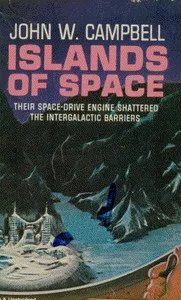
Islands of Space
by John W., Jr. (John Wood) Campbell
- Language
- EN
- Format
- EPUB
- Size
- 197 KB
Description
This is a science fiction novel written in prose form. It follows four protagonists—Arcot, Morey, Wade, and Fuller—as they undertake a voyage through distant realms. The narrative revolves around their technological innovations and adventures, set within a universe that features advanced concepts such as hyperspace and warp drive. The work exemplifies the "hard" science fiction tradition characteristic of its period, with a focus on scientifically plausible mechanisms and technological details.
Published in 1957, the novel is a sequel to "The Black Star Passes" and is grounded in the scientific knowledge of the era. It describes the characters' efforts to develop and utilise futuristic propulsion systems and mechanistic devices, highlighting the importance of scientific principles in the story. The novel reflects the genre's emphasis on technical accuracy and imaginative extrapolation of scientific concepts.
Published in 1957, the novel is a sequel to "The Black Star Passes" and is grounded in the scientific knowledge of the era. It describes the characters' efforts to develop and utilise futuristic propulsion systems and mechanistic devices, highlighting the importance of scientific principles in the story. The novel reflects the genre's emphasis on technical accuracy and imaginative extrapolation of scientific concepts.
From the opening pages
Richard Arcot, hailed as "the greatest living physicist", and Robert Morey, his brilliant mathematical assistant, discovered the so-called "molecular motion drive", which utilized the random energy of heat to produce useful motion. John Fuller, designing engineer, helped the two men to build a ship which used the drive in order to have a weapon to seek out and capture the mysterious Air Pirate whose robberies were ruining Transcontinental Airways. The Pirate, Wade, was a brilliant but neurotic chemist who had discovered, among other things, the secret of invisibility. Cured of his instability by modern psychomedical techniques, he was hired by Arcot to help build an interplanetary vessel to go to Venus. The Venusians proved to be a humanoid race of people who used telepathy for communication. Although they were similar to Earthmen, their blue blood and double thumbs made them enough different to have caused distrust and racial friction, had not both planets been drawn together in a common bond of defense by the passing of the Black Star. The Black Star, Nigra, was a dead, burned-out sun surrounded by a planetary system very much like our own. But these people had been forced to use their science to produce enough heat and light to stay alive in the cold, black depths of interstellar space. There was nothing evil or menacing in their attack on the Solar System; they simply wanted a star that gave off light and heat. So they attacked, not realizing that they were attacking beings equal in intelligence to themselves. They were at another disadvantage, too. The Nigrans had spent long millennia fighting their environment and had had no time to fight among themselves, so they knew nothing of how to wage a war. The Earthmen and Venusians knew only too well, since they had a long history of war on each planet. Inevitably, the Nigrans were driven back to the Black Star. [A] The war was over. And things became dull. And the taste of adventure still remained on the tongues of Arcot, Wade, and Morey. [A] See " The Black Star Passes ", Ace Books, F-346. I Three men sat around a table which was littered with graphs, sketches of mathematical functions, and books of tensor formulae. Beside the table stood a Munson-Bradley integraph calculator which one of the men was using to check some of the equations he had already derived. The results…
Ask about this book
An AI guide answers your questions about this title
FAQ
Is "Islands of Space" free to download?
Yes, it is free to download — no sign up needed.
What format is the file?
EPUB.
More by John W., Jr. (John Wood) Campbell



Similar books



Reader reviews Be the first
No reviews yet. Be the first to review this book.
Write a review
Protected by reCAPTCHA.