
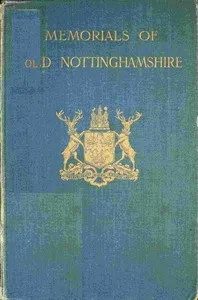
Memorials of old Nottinghamshire
by Anonymous
- Language
- EN
- Format
- EPUB
- Size
- 5.7 MB
Description
"Memorials of old Nottinghamshire" by Everard L. Guilford and P. H. Ditchfield is a collection of local-history essays written in the early 20th century. The volume surveys Nottinghamshire’s past and character through its geography, archaeology, churches, great houses, poets, industries, and civic episodes, richly illustrated and contributed by multiple specialists. Expect a county portrait shaped by the River Trent, Sherwood Forest, and historic centers such as Nottingham, Newark, and Southwell.
The opening of the volume offers a preface explaining the change of editor, the aim to cover varied and sometimes novel subjects, and thanks to contributors. It then begins with a brisk county history that argues for blending documents, tradition, and fieldwork; elevates the Trent and Sherwood as decisive forces; and sketches a timeline from prehistoric cave-dwellers through Roman byways that skirted Nottingham, Saxon borderland shifts, Danish rule and the Five Boroughs, and the Norman dual borough at Nottingham. The narrative follows the castle’s dominance, the town’s commercial rise, royal crises and battles touching Newark and Nottingham, the Civil War divide, and later industrial pivots—the stocking-frame sparking hosiery and lace, and expanding coalfields—ending with a call to read the present through the past. Next, an architectural essay contends the county is underrated, outlining how local masons, more than monasteries, shaped mostly simple but telling parish plans under the pull of York and Lincoln. It tours key examples from late Saxon and Norman fabric (e.g., Carlton-in-Lindrick, Blyth, Southwell) into Early English and Decorated phases (Newark’s tower logic, Thurgarton’s austere west front, Southwell’s quire and its celebrated chapter house carving), notes distinctive fourteenth-century chancels with rich stone furnishings and Easter sepulchres (Hawton, Sibthorpe, Car Colston, Woodborough), and closes by touching on later Perpendicular rebuilds like St. Mary’s, Nottingham, and the role of chantries in enlarging churches.
The opening of the volume offers a preface explaining the change of editor, the aim to cover varied and sometimes novel subjects, and thanks to contributors. It then begins with a brisk county history that argues for blending documents, tradition, and fieldwork; elevates the Trent and Sherwood as decisive forces; and sketches a timeline from prehistoric cave-dwellers through Roman byways that skirted Nottingham, Saxon borderland shifts, Danish rule and the Five Boroughs, and the Norman dual borough at Nottingham. The narrative follows the castle’s dominance, the town’s commercial rise, royal crises and battles touching Newark and Nottingham, the Civil War divide, and later industrial pivots—the stocking-frame sparking hosiery and lace, and expanding coalfields—ending with a call to read the present through the past. Next, an architectural essay contends the county is underrated, outlining how local masons, more than monasteries, shaped mostly simple but telling parish plans under the pull of York and Lincoln. It tours key examples from late Saxon and Norman fabric (e.g., Carlton-in-Lindrick, Blyth, Southwell) into Early English and Decorated phases (Newark’s tower logic, Thurgarton’s austere west front, Southwell’s quire and its celebrated chapter house carving), notes distinctive fourteenth-century chancels with rich stone furnishings and Easter sepulchres (Hawton, Sibthorpe, Car Colston, Woodborough), and closes by touching on later Perpendicular rebuilds like St. Mary’s, Nottingham, and the role of chantries in enlarging churches.
Ask about this book
An AI guide answers your questions about this title
FAQ
Is "Memorials of old Nottinghamshire" free to download?
Yes, it is free to download — no sign up needed.
What format is the file?
EPUB.
More by Anonymous




Reader reviews Be the first
No reviews yet. Be the first to review this book.
Write a review
Protected by reCAPTCHA.