
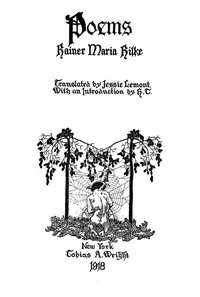
Poems
- Language
- EN
- Format
- EPUB
- Size
- 272 KB
Description
This collection of poetry by Rainer Maria Rilke features works that examine themes of solitude, love, mortality, and the relationship between life and art. Translated by Jessie Lamont and published in the early 20th century, the volume includes various sections such as early poems, the Book of Pictures, and the Book of Hours. These sections illustrate Rilke's development as a poet, highlighting his lyrical style, which combines mysticism with existential reflection. The poems evoke vivid imagery, often focusing on nature, spiritual significance, and the sacredness of artistic creation. Rilke's work is characterised by emotional depth and a contemplative tone that explores the human condition through symbolic language.
The collection reflects Rilke’s place in modern European literature, illustrating his influence on poetic expression in German literature of the period. The translated verses allow insight into his evolving poetic voice, marked by a fusion of personal introspection and universal themes. The work is notable for its lyrical quality and philosophical overtones, characteristic of early 20th-century modernist poetry.
The collection reflects Rilke’s place in modern European literature, illustrating his influence on poetic expression in German literature of the period. The translated verses allow insight into his evolving poetic voice, marked by a fusion of personal introspection and universal themes. The work is notable for its lyrical quality and philosophical overtones, characteristic of early 20th-century modernist poetry.
From the opening pages
To the Editors of Poetry—A magazine of Verse, and Poet Lore, the translator is indebted for permission to reprint certain poems in this book—also to the compilers of the following anthologies—Amphora II edited by Thomas Bird Mosher—The Catholic Anthology of World Poetry selected by Carl van Doren. Titlepage: Dugald Stewart Walker. THE POETRY OF RAINER MARIA RILKE εἶσὶ γὰρ οὖν, οἳ ἐν ταῖς ψυχαῖς κυοῦσιν Plato The supreme problem of every age is that of finding its consummate artistic expression. Before this problem every other remains of secondary importance. History defines and directs its physical course, science cooperates in the achievement of its material aims, but Art alone gives to the age its spiritual physiognomy, its ultimate and lasting expression. The process of Art is on the one hand sensuous, the conception having for its basis the fineness of organization of the senses; and on the other hand it is severely scientific, the value of the creation being dependent upon the craftsmanship, the mastery over the tool, the technique. Art, like Nature, its great and only reservoir for all time past and all time to come, ever strives for elimination and selection. It is severe and aristocratic in the application of its laws and impervious to appeal to serve other than its own aims. Its purpose is the symbolization of Life. In its sanctum there reigns the silence of vast accomplishment, the serene, final, and imperturbable solitude which is the ultimate criterion of all great things created. To speak of Poetry is to speak of the most subtle, the most delicate, and the most accurate instrument by which to measure Life. Poetry is reality's essence visioned and made manifest by one endowed with a perception acutely sensitive to sound, form, and colour, and gifted with a power to shape into rhythmic and rhymed verbal symbols the reaction to Life's phenomena. The poet moulds that which appears evanescent and ephemeral in image and in mood into everlasting values. In this act of creation he serves eternity. Poetry, in especial lyrical poetry, must be acknowledged the supreme art, culminating as it does in a union of the other arts, the musical, the plastic, and the pictorial. The most eminent contemporary poets of Europe have, each in accordance with his individual temperament, reflected in their work the spiritual essence of our age, its fears and failures, its hopes and high achievements: Maeterlinck, with…
Ask about this book
An AI guide answers your questions about this title
FAQ
Is "Poems" free to download?
Yes, it is free to download — no sign up needed.
What format is the file?
EPUB.
More by Rainer Maria Rilke
Similar books


Reader reviews Be the first
No reviews yet. Be the first to review this book.
Write a review
Protected by reCAPTCHA.