
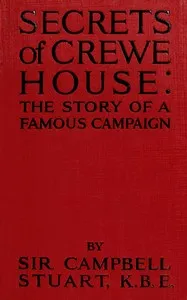
Secrets of Crewe House: The story of a famous campaign
- Language
- EN
- Format
- EPUB
- Size
- 10 MB
Description
"Secrets of Crewe House" by Campbell Stuart is a historical account written in the early 20th century. It traces how Britain orchestrated and delivered propaganda into enemy countries during the closing year of the Great War, under Viscount Northcliffe’s leadership. The work emphasizes strategy, organization, and inter-Allied cooperation, showing how targeted messaging weakened enemy morale—most strikingly in Austria-Hungary and then in Germany.
The opening of the work sets out its purpose and limits: it records a pioneering wartime effort whose full details cannot always be revealed, arguing that the results—and even German reactions—prove its impact. It defines propaganda as truth-based, consistent, and discreet, explains how to create a receptive “atmosphere,” and contrasts these principles with Germany’s failed, contradictory efforts, underscored by Ludendorff’s later laments. It then outlines the department’s creation, staff, and structure at Crewe House, its close daily coordination with other British offices, and its modest budget. The first major campaign targeted Austria-Hungary by backing subject nationalities’ aspirations and sapping frontline resolve; through the Rome Congress, an inter-Allied commission, and mass leafleting, songs, and patrols, desertions rose and the Piave offensive faltered—despite Italian political hesitations. Turning to Germany, the narrative notes Britain’s early neglect, later War Office initiatives like Le Courrier de l’Air, the shift from aeroplane drops to ingenious hydrogen balloons, and the scaling up of leaflet delivery. It closes this opening section with H. G. Wells’s policy framework: pair unwavering Allied resolve with a credible postwar settlement—a League of Free Nations—and press for internal change in Germany as the only path to peace.
The opening of the work sets out its purpose and limits: it records a pioneering wartime effort whose full details cannot always be revealed, arguing that the results—and even German reactions—prove its impact. It defines propaganda as truth-based, consistent, and discreet, explains how to create a receptive “atmosphere,” and contrasts these principles with Germany’s failed, contradictory efforts, underscored by Ludendorff’s later laments. It then outlines the department’s creation, staff, and structure at Crewe House, its close daily coordination with other British offices, and its modest budget. The first major campaign targeted Austria-Hungary by backing subject nationalities’ aspirations and sapping frontline resolve; through the Rome Congress, an inter-Allied commission, and mass leafleting, songs, and patrols, desertions rose and the Piave offensive faltered—despite Italian political hesitations. Turning to Germany, the narrative notes Britain’s early neglect, later War Office initiatives like Le Courrier de l’Air, the shift from aeroplane drops to ingenious hydrogen balloons, and the scaling up of leaflet delivery. It closes this opening section with H. G. Wells’s policy framework: pair unwavering Allied resolve with a credible postwar settlement—a League of Free Nations—and press for internal change in Germany as the only path to peace.
Ask about this book
An AI guide answers your questions about this title
FAQ
Is "Secrets of Crewe House: The story of a famous campaign" free to download?
Yes, it is free to download — no sign up needed.
What format is the file?
EPUB.
Reader reviews Be the first
No reviews yet. Be the first to review this book.
Write a review
Protected by reCAPTCHA.