
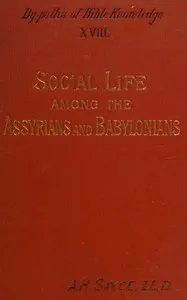
Social life among the Assyrians and Babylonians
by A. H. (Archibald Henry) Sayce
- Language
- EN
- Format
- EPUB
- Size
- 279 KB
Description
"Social life among the Assyrians and Babylonians" by A. H. Sayce is a historical account written in the late 19th century. It surveys everyday life, social institutions, economy, religion, and customs in Babylonia and Assyria, drawing on cuneiform texts and archaeology and often comparing the two cultures to illuminate the biblical world.
The opening of the book sets its popular-scholarly aim, then outlines who the peoples were and how their environments shaped them: mixed, irrigating, trade-minded Babylonia versus more uniformly Semitic, militarized, commercially driven Assyria, with contrasting religious temperaments and differing historical fates. It describes materials and architecture (brick in Babylonia, stone and brick in Assyria), house plans and décor, furnishings, gardens and irrigation, dining and sleeping habits, and detailed dress and grooming, including priestly attire and the fashioning of hair and beards. Education receives special emphasis: widespread Babylonian literacy, clay-tablet libraries in temples, bilingual study of Sumerian (Accadian), use of Aramaic as a lingua franca, school subjects, and public access to collections. The narrative then treats marriage law and women’s property rights, dowries and divorce, adoption and name-giving, temple colleges, and burial customs featuring cremation/partial cremation, tomb offerings, and water for the dead. Markets, prices, wages, payments in kind, partnerships (including women’s roles), moneylending and interest, taxation, and meticulous real-estate contracts are illustrated from tablets—extending even to Belshazzar’s commercial dealings. Finally, slavery is examined alongside largely free agricultural labor, with legal protections, routes to manumission, family sales, classes of slaves, cooperative tenures, and preserved farming songs and proverbs; the next chapter on trades and professions is just introduced.
The opening of the book sets its popular-scholarly aim, then outlines who the peoples were and how their environments shaped them: mixed, irrigating, trade-minded Babylonia versus more uniformly Semitic, militarized, commercially driven Assyria, with contrasting religious temperaments and differing historical fates. It describes materials and architecture (brick in Babylonia, stone and brick in Assyria), house plans and décor, furnishings, gardens and irrigation, dining and sleeping habits, and detailed dress and grooming, including priestly attire and the fashioning of hair and beards. Education receives special emphasis: widespread Babylonian literacy, clay-tablet libraries in temples, bilingual study of Sumerian (Accadian), use of Aramaic as a lingua franca, school subjects, and public access to collections. The narrative then treats marriage law and women’s property rights, dowries and divorce, adoption and name-giving, temple colleges, and burial customs featuring cremation/partial cremation, tomb offerings, and water for the dead. Markets, prices, wages, payments in kind, partnerships (including women’s roles), moneylending and interest, taxation, and meticulous real-estate contracts are illustrated from tablets—extending even to Belshazzar’s commercial dealings. Finally, slavery is examined alongside largely free agricultural labor, with legal protections, routes to manumission, family sales, classes of slaves, cooperative tenures, and preserved farming songs and proverbs; the next chapter on trades and professions is just introduced.
Ask about this book
An AI guide answers your questions about this title
FAQ
Is "Social life among the Assyrians and Babylonians" free to download?
Yes, it is free to download — no sign up needed.
What format is the file?
EPUB.
More by A. H. (Archibald Henry) Sayce




Reader reviews Be the first
No reviews yet. Be the first to review this book.
Write a review
Protected by reCAPTCHA.