

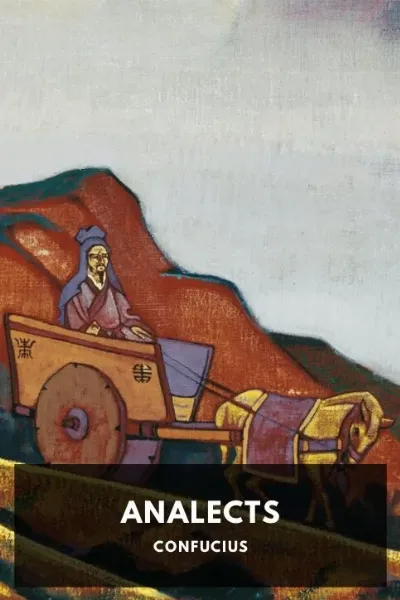
The Analects of Confucius (from the Chinese Classics)
by Confucius
- Language
- EN
- Format
- EPUB
- Size
- 142 KB
Description
Written during the Warring States period (475–221 BC) and completed in the mid-Han dynasty, The Analects of Confucius is a collection of sayings and dialogues attributed to Confucius, a central figure in Chinese philosophy. The text records his discussions on moral virtues, proper conduct, and governance, emphasizing principles such as ren (virtue), filial piety, and li (ritual propriety). Its focus lies on ethical cultivation and the role of moral character in personal development and political stability. The work forms a foundational component of classical Chinese thought and has influenced subsequent Chinese education, government, and social philosophy for centuries.
The Analects has been preserved as part of the Chinese Classics and has been translated into multiple languages, serving as a key reference for understanding ancient Chinese values and leadership ideals. Its compilation reflects the philosophical debates of its period, presenting Confucius's teachings through a dialogue-driven format that highlights the importance of moral integrity and proper ritual. The text continues to be studied for its insights on personal and societal virtues.
The Analects has been preserved as part of the Chinese Classics and has been translated into multiple languages, serving as a key reference for understanding ancient Chinese values and leadership ideals. Its compilation reflects the philosophical debates of its period, presenting Confucius's teachings through a dialogue-driven format that highlights the importance of moral integrity and proper ritual. The text continues to be studied for its insights on personal and societal virtues.
From the opening pages
It is the English translation portion of the CONFUCIAN ANALECTS, which is one part of Legge's THE CHINESE CLASSICS. The Prolegomena, The Great Learning, and The Doctrine of the Mean can be found in other Project Gutenberg files. The original Chinese of the CONFUCIAN ANALECTS and Legge's notes are presented along with this English translation in other Project Gutenberg files. THE CHINESE CLASSICS with a translation, critical and exegetical notes, prolegomena, and copious indexes by James Legge IN FIVE VOLUMES CONFUCIAN ANALECTS THE GREAT LEARNING THE DOCTRINE OF THE MEAN CONFUCIAN ANALECTS. CHAPTER I. 1. The Master said, 'Is it not pleasant to learn with a constant perseverance and application? 2. 'Is it not delightful to have friends coming from distant quarters?' 3. 'Is he not a man of complete virtue, who feels no discomposure though men may take no note of him?' CHAP. II. 1. The philosopher Yu said, 'They are few who, being filial and fraternal, are fond of offending against their superiors. There have been none, who, not liking to offend against their superiors, have been fond of stirring up confusion. 2. 'The superior man bends his attention to what is radical. That being established, all practical courses naturally grow up. Filial piety and fraternal submission!— are they not the root of all benevolent actions?' CHAP. III. The Master said, 'Fine words and an insinuating appearance are seldom associated with true virtue.' CHAP. IV. The philosopher Tsang said, 'I daily examine myself on three points:— whether, in transacting business for others, I may have been not faithful;— whether, in intercourse with friends, I may have been not sincere;— whether I may have not mastered and practised the instructions of my teacher.' CHAP. V. The Master said, To rule a country of a thousand chariots, there must be reverent attention to business, and sincerity; economy in expenditure, and love for men; and the employment of the people at the proper seasons.' CHAP. VI. The Master said, 'A youth, when at home, should be filial, and, abroad, respectful to his elders. He should be earnest and truthful. He should overflow in love to all, and cultivate the friendship of the good. When he has time and opportunity, after the performance of these things, he should employ them in polite studies.' CHAP. VII. Tsze-hsia said, 'If a man withdraws his mind from the love of beauty, and applies it as…
Ask about this book
An AI guide answers your questions about this title
FAQ
Is "The Analects of Confucius (from the Chinese Classics)" free to download?
Yes, it is free to download — no sign up needed.
What format is the file?
EPUB.
More by Confucius



Similar books



Reader reviews Be the first
No reviews yet. Be the first to review this book.
Write a review
Protected by reCAPTCHA.