
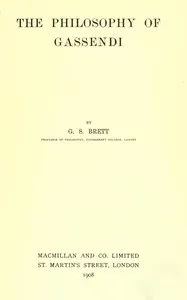
The philosophy of Gassendi
- Language
- EN
- Format
- EPUB
- Size
- 454 KB
Description
"The philosophy of Gassendi" by George Sidney Brett is a scholarly study of philosophy written in the early 20th century. It reassesses Pierre Gassendi’s system—logic, physics, and ethics—within the lineage of ancient atomism and its early modern revival, aiming to correct his neglect and clarify his influence. The work synthesizes Gassendi’s vast Syntagma and related writings, situating him among Epicurus, Democritus, Aristotle, and Descartes to show his empirical, pluralist alternative to dominant idealisms.
The opening of the book sets out Brett’s purpose: to condense Gassendi’s sprawling scholarship into a clear, reliable account and to restore his place in the history of philosophy, favoring breadth, concreteness, and empirical restraint over Cartesian abstraction. It provides a bibliography and a detailed catalogue of Gassendi’s works, then traces the background from Leucippus and Democritus to Epicurus—marking shifts from Eleatic roots to atomist pluralism, from Democritean mechanics to Epicurean canons, swerve, material psychology, and ethics-first method. Brett sketches the early modern context of science challenging dogma, outlines Gassendi’s life and character, and positions him as a moderate critic of Aristotelianism and Descartes who builds a comprehensive, experience-based system. In Part I (Logic), the summary highlights Epicurean-inspired criteria—sensation, anticipations, and feelings—asserting sense as the starting point, opinions testable by experience, and inference from signs as the path from the known to the occult, while steering a middle course between scepticism and dogmatism and retaining the syllogism and method. At the start of Part II (Physics), nature is treated concretely as the totality of things, with cautious agnosticism about multiple worlds, a rejection of a world-soul, and a guarded preference for Tycho’s astronomy (out of deference to scripture) despite sympathy with Copernicus. Creation is affirmed against an eternal world, and the discussion of time and space begins by treating space as a real, independent, incorporeal, continuous quantity—akin to a substance, possibly infinite—while acknowledging the puzzles this view raises.
The opening of the book sets out Brett’s purpose: to condense Gassendi’s sprawling scholarship into a clear, reliable account and to restore his place in the history of philosophy, favoring breadth, concreteness, and empirical restraint over Cartesian abstraction. It provides a bibliography and a detailed catalogue of Gassendi’s works, then traces the background from Leucippus and Democritus to Epicurus—marking shifts from Eleatic roots to atomist pluralism, from Democritean mechanics to Epicurean canons, swerve, material psychology, and ethics-first method. Brett sketches the early modern context of science challenging dogma, outlines Gassendi’s life and character, and positions him as a moderate critic of Aristotelianism and Descartes who builds a comprehensive, experience-based system. In Part I (Logic), the summary highlights Epicurean-inspired criteria—sensation, anticipations, and feelings—asserting sense as the starting point, opinions testable by experience, and inference from signs as the path from the known to the occult, while steering a middle course between scepticism and dogmatism and retaining the syllogism and method. At the start of Part II (Physics), nature is treated concretely as the totality of things, with cautious agnosticism about multiple worlds, a rejection of a world-soul, and a guarded preference for Tycho’s astronomy (out of deference to scripture) despite sympathy with Copernicus. Creation is affirmed against an eternal world, and the discussion of time and space begins by treating space as a real, independent, incorporeal, continuous quantity—akin to a substance, possibly infinite—while acknowledging the puzzles this view raises.
Ask about this book
An AI guide answers your questions about this title
FAQ
Is "The philosophy of Gassendi" free to download?
Yes, it is free to download — no sign up needed.
What format is the file?
EPUB.
Reader reviews Be the first
No reviews yet. Be the first to review this book.
Write a review
Protected by reCAPTCHA.