
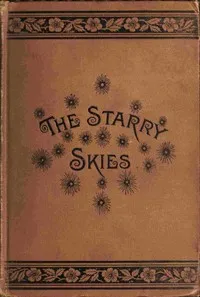
The starry skies: or, First lessons on the sun, moon and stars
- Language
- EN
- Format
- EPUB
- Size
- 3 MB
Description
"The starry skies" by Agnes Giberne is a children's astronomy primer written in the late 19th century. Aimed at beginners, it explains the Earth, Moon, Sun, and stars through clear analogies, simple experiments, and short Q&A sections, emphasizing basic ideas like the Earth’s shape, gravity, day and night, lunar phases, and the Sun’s nature.
The opening of the book moves from first principles to sky-watching essentials. It starts by proving the Earth is a sphere using travel-and-spider analogies, the horizon, poles, equator, and hemispheres, then explains gravity (attraction) as the reason people don’t “fall off” on the far side of the globe and frames Earth as a bright world in space. It describes the Sun’s apparent daily path, equinoxes and solstices, the zenith, and the stars’ east‑to‑west drift, before showing that these motions are illusions caused by Earth’s rotation on its axis. Next it introduces the Moon’s size and distance with scale models (Earth a 4‑inch ball, Moon 1‑inch, 10 feet apart), the Moon’s phases and synchronous rotation (one side always facing us), and its fortnight-long day and night. Through the telescope it portrays a stark, airless Moon marked by mountains and vast volcanic craters, extreme temperatures, a black daytime sky, and lower gravity. It then outlines the Sun’s enormous size and distance, why it and the Moon look similar in apparent size, distinguishes reflected light from self-luminous stars, and begins a discussion of sunspots and the Sun’s rotation.
The opening of the book moves from first principles to sky-watching essentials. It starts by proving the Earth is a sphere using travel-and-spider analogies, the horizon, poles, equator, and hemispheres, then explains gravity (attraction) as the reason people don’t “fall off” on the far side of the globe and frames Earth as a bright world in space. It describes the Sun’s apparent daily path, equinoxes and solstices, the zenith, and the stars’ east‑to‑west drift, before showing that these motions are illusions caused by Earth’s rotation on its axis. Next it introduces the Moon’s size and distance with scale models (Earth a 4‑inch ball, Moon 1‑inch, 10 feet apart), the Moon’s phases and synchronous rotation (one side always facing us), and its fortnight-long day and night. Through the telescope it portrays a stark, airless Moon marked by mountains and vast volcanic craters, extreme temperatures, a black daytime sky, and lower gravity. It then outlines the Sun’s enormous size and distance, why it and the Moon look similar in apparent size, distinguishes reflected light from self-luminous stars, and begins a discussion of sunspots and the Sun’s rotation.
Ask about this book
An AI guide answers your questions about this title
FAQ
Is "The starry skies: or, First lessons on the sun, moon and stars" free to download?
Yes, it is free to download — no sign up needed.
What format is the file?
EPUB.
More by Agnes Giberne




Similar books



Reader reviews Be the first
No reviews yet. Be the first to review this book.
Write a review
Protected by reCAPTCHA.