
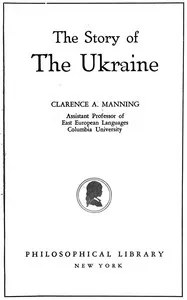
The story of the Ukraine
- Language
- EN
- Format
- EPUB
- Size
- 765 KB
Description
The story of the Ukraine by Clarence Augustus Manning is a historical account written in the mid-20th century. Framed by Ukraine’s admission to the United Nations and the author’s insistence on Ukraine’s thousand-year statehood, it surveys the land’s geography and resources, the rise of Kievan Rus, the cultural and religious struggles under Polish-Lithuanian rule, the emergence of the Kozaks, modern national awakenings, and the traumas of the Soviet era and two world wars.
The opening of the work argues that Ukraine is an enduring nation, not a propagandistic invention, and sets its story within Europe’s great currents. It recounts Kievan Rus as a wealthy, cultured power Christianized from Constantinople, then fragmented by internal feuds, the sack of Kiev in 1169, and the Mongol conquest in 1240, after which Muscovy developed separately under Tatar influence while western Ukrainian lands fell to Poland and Lithuania. It explains the politicized struggle over names—Rus’, Ruthenia, and Ukraine—as a window into competing claims of identity and heritage. It then sketches a 16th–17th century cultural revival led by Orthodox brotherhoods and schools (Ostrih, Lviv, and the Kiev Academy under Peter Mohyla), the polemics and rupture around the Union of Brest, and finally introduces the Kozaks: frontier warriors of the Zaporozhian Sich whose egalitarian, disciplined host raided Ottoman shores, fought in regional wars, defied Polish magnates, and became the armed voice of an oppressed Ukrainian populace.
The opening of the work argues that Ukraine is an enduring nation, not a propagandistic invention, and sets its story within Europe’s great currents. It recounts Kievan Rus as a wealthy, cultured power Christianized from Constantinople, then fragmented by internal feuds, the sack of Kiev in 1169, and the Mongol conquest in 1240, after which Muscovy developed separately under Tatar influence while western Ukrainian lands fell to Poland and Lithuania. It explains the politicized struggle over names—Rus’, Ruthenia, and Ukraine—as a window into competing claims of identity and heritage. It then sketches a 16th–17th century cultural revival led by Orthodox brotherhoods and schools (Ostrih, Lviv, and the Kiev Academy under Peter Mohyla), the polemics and rupture around the Union of Brest, and finally introduces the Kozaks: frontier warriors of the Zaporozhian Sich whose egalitarian, disciplined host raided Ottoman shores, fought in regional wars, defied Polish magnates, and became the armed voice of an oppressed Ukrainian populace.
Ask about this book
An AI guide answers your questions about this title
FAQ
Is "The story of the Ukraine" free to download?
Yes, it is free to download — no sign up needed.
What format is the file?
EPUB.
More by Clarence Augustus Manning
Reader reviews Be the first
No reviews yet. Be the first to review this book.
Write a review
Protected by reCAPTCHA.