
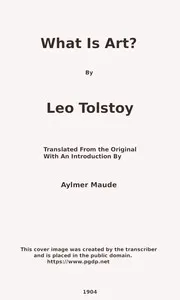
What Is Art?
- Language
- EN
- Format
- EPUB
- Size
- 297 KB
Description
Leo Tolstoy's "What Is Art?" is a philosophical treatise examining the nature and purpose of art within society. Completed in 1897, the work challenges traditional aesthetic notions rooted in beauty and technical mastery, proposing instead that authentic art is any expression that communicates genuine emotion. Tolstoy advocates for art that is accessible and understandable to all individuals, asserting its role in promoting moral and spiritual development. He criticises the artificiality and exclusivity of contemporary artistic standards, condemning certain renowned composers, playwrights, and writers for their perceived detachment from moral aims. The book reflects Tolstoy's Christian moralism and his view of art as a tool for fostering brotherhood and love, rather than as an end in itself.
The work situates itself within late 19th-century debates about art's societal function and morality, blending philosophical reflection with social critique. It dismisses art as a means of superficial entertainment, focusing instead on its capacity to serve moral and spiritual growth by conveying truth and fostering human connection.
The work situates itself within late 19th-century debates about art's societal function and morality, blending philosophical reflection with social critique. It dismisses art as a means of superficial entertainment, focusing instead on its capacity to serve moral and spiritual growth by conveying truth and fostering human connection.
From the opening pages
so little poetry and colour in their lives—let them at least enjoy what they have; it would be cruel to undeceive them,” said she. A false and antiquated view of life is supported by means of art, and is inseparably linked to some manifestations of art which we enjoy and prize. If the false view of life be destroyed this art will cease to appear valuable. Is it best to screen the error for the sake of preserving the art? Or should the art be sacrificed for the sake of truthfulness? Again and again in history a dominant church has utilised art to maintain its sway over men. Reformers (early Christians, Mohammedans, Puritans, and others) have perceived that art bound people to the old faith, and they were angry with art. They diligently chipped the noses from statues and images, and were wroth with ceremonies, decorations, stained-glass windows, and processions. They were even ready to banish art altogether, for, besides the superstitions it upheld, they saw that it depraved and perverted men by dramas, drinking-songs, novels, pictures, and dances, of a kind that awakened man’s lower nature. Yet art always reasserted her sway, and to-day we are told by many that art has nothing to do with morality—that “art should be followed for art’s sake.” I went one day, with a lady artist, to the Bodkin Art Gallery in Moscow. In one of the rooms, on a table, lay a book of coloured pictures, issued in Paris and supplied, I believe, to private subscribers only. The pictures were admirably executed, but represented scenes in the private cabinets of a restaurant. Sexual indulgence was the chief subject of each picture. Women extravagantly dressed and partly undressed, women exposing their legs and breasts to men in evening dress; men and women taking liberties with each other, or dancing the “can-can,” etc., etc. My companion the artist, a maiden lady of irreproachable conduct and reputation, began deliberately to look at these pictures. I could not let my attention dwell on them without ill effects. Such things had a certain attraction for me, and tended to make me restless and nervous. I ventured to suggest that the subject-matter of the pictures was objectionable. But my companion (who prided herself on being an artist) remarked with conscious superiority, that from an artist’s point of view the subject was of no consequence.
Ask about this book
An AI guide answers your questions about this title
FAQ
Is "What Is Art?" free to download?
Yes, it is free to download — no sign up needed.
What format is the file?
EPUB.
More by Leo, graf Tolstoy




Similar books

Reader reviews Be the first
No reviews yet. Be the first to review this book.
Write a review
Protected by reCAPTCHA.