
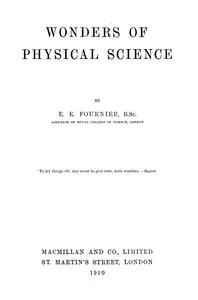
Wonders of physical science
by E. E. (Edmund Edward) Fournier d'Albe
- Language
- EN
- Format
- EPUB
- Size
- 2.8 MB
Description
"Wonders of physical science" by E. E. Fournier d'Albe is a popular science survey written in the early 20th century. It offers an engaging, historically framed tour of key ideas and instruments in physics, showing how observation, experiment, and ingenuity shaped everyday technologies. Aimed at curious readers and students, it blends vivid biography with clear explanations to inspire interest in scientific thinking and its human story.
The opening of the volume lays out the series’ purpose—readable, inspiring science for schools and general readers—then begins a lively historical arc. It sketches Archimedes’ lever, screw, and buoyancy principle (via the golden crown), his war machines, and his death at Syracuse. It next highlights Alexandria’s lighthouse, library, and scholars: Aristarchus gauging sun–moon distances, Eratosthenes measuring Earth’s size, and Heron’s devices (early steam toy, water clocks, surveying level). The narrative shifts to the Arab world’s chemistry and optics, centering on Alhazen’s straight-line light, reflection and refraction studies, the moon-size illusion, and the concept of specific gravity. Turning to early modern Europe, it celebrates Gilbert’s experimental method and his case for Earth as a magnet, then Galileo’s experiments on falling bodies and pendulums, invention of the telescope, and celestial discoveries despite opposition. Foundational fluid and air studies follow: Torricelli’s mercury barometer and Pascal’s mountain test, then Guericke’s vacuum feats and Boyle’s “spring of the air,” showing sound fails in a vacuum. It concludes this opening stretch with Denis Papin’s improvements to the air-pump, practical pumping schemes, diving apparatus, centrifugal pump, and the pressure “digester,” setting the stage for the steam engine.
The opening of the volume lays out the series’ purpose—readable, inspiring science for schools and general readers—then begins a lively historical arc. It sketches Archimedes’ lever, screw, and buoyancy principle (via the golden crown), his war machines, and his death at Syracuse. It next highlights Alexandria’s lighthouse, library, and scholars: Aristarchus gauging sun–moon distances, Eratosthenes measuring Earth’s size, and Heron’s devices (early steam toy, water clocks, surveying level). The narrative shifts to the Arab world’s chemistry and optics, centering on Alhazen’s straight-line light, reflection and refraction studies, the moon-size illusion, and the concept of specific gravity. Turning to early modern Europe, it celebrates Gilbert’s experimental method and his case for Earth as a magnet, then Galileo’s experiments on falling bodies and pendulums, invention of the telescope, and celestial discoveries despite opposition. Foundational fluid and air studies follow: Torricelli’s mercury barometer and Pascal’s mountain test, then Guericke’s vacuum feats and Boyle’s “spring of the air,” showing sound fails in a vacuum. It concludes this opening stretch with Denis Papin’s improvements to the air-pump, practical pumping schemes, diving apparatus, centrifugal pump, and the pressure “digester,” setting the stage for the steam engine.
Ask about this book
An AI guide answers your questions about this title
FAQ
Is "Wonders of physical science" free to download?
Yes, it is free to download — no sign up needed.
What format is the file?
EPUB.
More by E. E. (Edmund Edward) Fournier d'Albe
Similar books
Reader reviews Be the first
No reviews yet. Be the first to review this book.
Write a review
Protected by reCAPTCHA.