
Your download link has expired — please click the download button again.
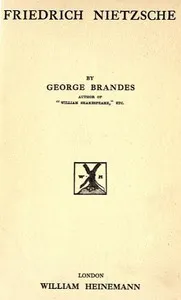
Friedrich Nietzsche
- Language
- EN
- Format
- EPUB
- Size
- 376 KB
Description
Published in the early 20th century, this biography by Georg Brandes provides an analytical account of Friedrich Nietzsche’s life and philosophical development. It situates Nietzsche within the context of German intellectual history, highlighting his role as a critic of societal norms and traditional morality. The work discusses his early academic career, literary output, and the evolution of his ideas, especially his critique of culture and emphasis on individuality. Brandes portrays Nietzsche as a provocative figure whose writings stirred controversy and debate, while also emphasizing his significance in German literature and philosophy. The biography aims to present a detailed portrait of Nietzsche’s contributions and the impact of his radical thoughts on morality and culture, making it suitable for scholarly reference or for those interested in early 20th-century biographical analysis of influential thinkers.
From the opening pages
Friedrich Nietzsche appears to me the most interesting writer in German literature at the present time. Though little known even in his own country, he is a thinker of a high order, who fully deserves to be studied, discussed, contested and mastered. Among many good qualities he has that of imparting his mood to others and setting their thoughts in motion. During a period of eighteen years Nietzsche has written a long series of books and pamphlets. Most of these volumes consist of aphorisms, and of these the greater part, as well as the more original, are concerned with moral prejudices. In this province will be found his lasting importance. But besides this he has dealt with the most varied problems; he has written on culture and history, on art and women, on companionship and solitude, on the State and society, on life's struggle and death. He was born on October 15, 1844; studied philology; became in 1869 professor of philology at Basle; made the acquaintance of Richard Wagner and became warmly attached to him, and associated also with the distinguished historian of the Renaissance, Jakob Burkhardt. Nietzsche's admiration and affection for Burkhardt were lasting. His feeling for Wagner, on the other hand, underwent a complete revulsion in the course of years. From having been Wagner's prophet he developed into his most passionate opponent. Nietzsche was always heart and soul a musician; he even tried his hand as a composer in his Hymn to Life (for chorus and orchestra, 1888), and his intercourse with Wagner left deep traces in his earliest writings. But the opera of Parsifal, with its tendency to Catholicism and its advancement of the ascetic ideals which had previously been entirely foreign to Wagner, caused Nietzsche to see in the great composer a danger, an enemy, a morbid phenomenon, since this last work showed him all the earlier operas in a new light. During his residence in Switzerland Nietzsche came to know a large circle of interesting people. He suffered, however, from extremely severe headaches, so frequent that they incapacitated him for about two hundred days in the year and brought him to the verge of the grave. In 1879 he resigned his professorship. From 1882 to 1888 his state of health improved, though extremely slowly. His eyes were still so weak that he was threatened with blindness. He was compelled to be extremely careful in his…
FAQ
Is "Friedrich Nietzsche" free to download?
Yes, it is free to download — no sign up needed.
What format is the file?
EPUB.
More by Georg Brandes



Similar books





Reader reviews Be the first
No reviews yet. Be the first to review this book.
Write a review
Protected by reCAPTCHA.