
Your download link has expired — please click the download button again.
Leviathan
- Language
- EN
- Format
- EPUB
- Size
- 840 KB
Description
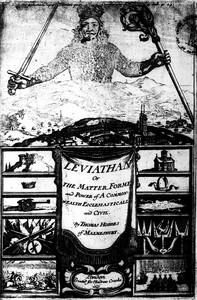
Leviathan is a philosophical treatise written by Thomas Hobbes and published in 1651. It argues that humans in their natural state exist in a perpetual conflict, which Hobbes describes as a "war of all against all," motivated by self-interest and the fear of violent death. Hobbes contends that to escape this chaos, individuals must consent to relinquish certain freedoms and establish a collective authority. The work develops a theory of social contract, advocating for a powerful, absolute sovereign who has both secular and spiritual authority to maintain peace and order within society.
The text situates itself within the context of the English Civil War, reflecting on the necessity of centralised political power to prevent civil disorder. It presents a materialistic view of human nature and explores the foundations of legitimate government, emphasizing the importance of a unified authority to ensure societal stability. The work is considered a foundational text in early modern political philosophy.
The text situates itself within the context of the English Civil War, reflecting on the necessity of centralised political power to prevent civil disorder. It presents a materialistic view of human nature and explores the foundations of legitimate government, emphasizing the importance of a unified authority to ensure societal stability. The work is considered a foundational text in early modern political philosophy.
From the opening pages
which in turn was prepared from the first edition. I have tried to follow as closely as possible the original, and to give the flavour of the text that Hobbes himself proof-read, but the following differences were unavoidable. Hobbes used capitals and italics very extensively, for emphasis, for proper names, for quotations, and sometimes, it seems, just because. The original has very extensive margin notes, which are used to show where he introduces the definitions of words and concepts, to give in short the subject that a paragraph or section is dealing with, and to give references to his quotations, largely but not exclusively biblical. To some degree, these margin notes seem to have been intended to serve in place of an index, the original having none. They are all in italics. He also used italics for words in other languages than English, and there are a number of Greek words, in the Greek alphabet, in the text. To deal with these within the limits of plain vanilla ASCII, I have done the following in this E-text. I have restricted my use of full capitalization to those places where Hobbes used it, except in the chapter headings, which I have fully capitalized, where Hobbes used a mixture of full capitalization and italics. Where it is clear that the italics are to indicate the text is quoting, I have introduced quotation marks. Within quotation marks I have retained the capitalization that Hobbes used. Where italics seem to be used for emphasis, or for proper names, or just because, I have capitalized the initial letter of the words. This has the disadvantage that they are not then distinguished from those that Hobbes capitalized in plain text, but the extent of his italics would make the text very ugly if I was to use an underscore or slash. Where the margin notes are either to introduce the paragraph subject, or to show where he introduces word definitions, I have included them as headers to the paragraph, again with all words having initial capitals, and on a shortened line. For margin references to quotes, I have included them in the text, in brackets immediately next to the quotation. Where Hobbes included references in the main text, I have left them as he put them, except to change his square brackets to round. For the Greek alphabet, I have simply substituted the nearest ordinary letters…
FAQ
Is "Leviathan" free to download?
Yes, it is free to download — no sign up needed.
What format is the file?
EPUB.
More by Thomas Hobbes

Similar books






Reader reviews Be the first
No reviews yet. Be the first to review this book.
Write a review
Protected by reCAPTCHA.