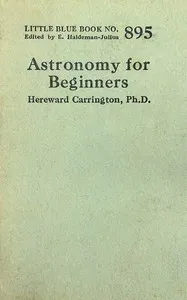
Astronomy for beginners
- Language
- EN
- Format
- EPUB
Description
Astronomy for beginners by Hereward Carrington is a compact popular-science primer written in the early 20th century. It offers a clear, accessible introduction to astronomy for lay readers, outlining how the cosmos works and how we study it.
The book opens by separating astronomy from astrology, then tours the solar system: the Sun (its layers, spots, and influence), each planet from Mercury to Neptune (with notes on moons, rings, atmospheres, and habitability), the minor planets, and the Moon’s features, phases, and origin. It surveys theories of solar-system formation (from Laplace to the planetesimal hypothesis), maps the sky’s constellations, and explains meteors, meteorites, comets, nebulae, and the Milky Way. Carrington summarizes stellar facts—numbers, distances (light-years), motions, temperatures, and types (fixed, double, colored, variable, temporary), plus star clusters. He describes eclipses, transits, and occultations, and introduces the tools that revolutionized astronomy—telescopes, spectroscopy, and photography. Core physical ideas follow: tides, gravitation, the ether (as then conceived), and atomic analogies; alongside atmospheric and geophysical topics such as lightning, fireballs, magnetism, and the aurora. Practical matters—measuring time and space, the International Date Line, calendars—lead to brief notes on curved space, the darkness and cold of interstellar space, prospects for life beyond Earth, possible causes of ice ages, why stars twinkle, the Moon’s size illusion, and a closing set of concise definitions. (This is an automatically generated summary.)
Summary
Astronomy for beginners by Hereward Carrington is a compact popular-science primer written in the early 20th century. It offers a clear, accessible introduction to astronomy for lay readers, outlining how the cosmos works and how we study it. The book opens by separating astronomy from astrology, then tours the solar system: the Sun (its layers, spots, and influence), each planet from Mercury to Neptune (with notes on moons, rings, atmospheres, and habitability), the minor p
FAQ
Is "Astronomy for beginners" free to download?
Yes, it is free to download — no sign up needed.
What format is the file?
EPUB.
Reader reviews Be the first
No reviews yet. Be the first to review this book.
Write a review
Protected by reCAPTCHA.