
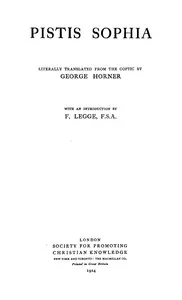
Pistis Sophia
by Anonymous
- Language
- EN
- Format
- EPUB
- Size
- 385 KB
Description
"Pistis Sophia" is a Gnostic text likely composed between the third and fourth centuries AD. It presents teachings delivered by the resurrected Jesus to his disciples, including Mary Magdalene, Mary, and Martha. These teachings expound upon the higher mysteries and cosmological concepts essential to Gnostic belief. The narrative focuses on the myth of Pistis Sophia, a divine figure who falls from grace and seeks redemption through repentance. Her story is intertwined with biblical allegories and emphasizes the importance of spiritual knowledge as a pathway to divine realms. The work contributes to the understanding of early Christian heterodoxies, especially Gnostic cosmology, and reflects the spiritual and theological debates of the period.
The text is a key source for studying early Gnostic Christianity and the variety of beliefs circulating in the Roman Empire during the third and fourth centuries AD. It provides insights into the mythologies and spiritual doctrines that challenged orthodox Christian teachings of the era.
The text is a key source for studying early Gnostic Christianity and the variety of beliefs circulating in the Roman Empire during the third and fourth centuries AD. It provides insights into the mythologies and spiritual doctrines that challenged orthodox Christian teachings of the era.
From the opening pages
The history of Gnosticism, which may be defined as the belief that man’s place in the next world is determined by the knowledge of it that he acquires in this, goes back probably to the very dawn of our civilisation; but its importance for most of us is mainly centred round the first three centuries of our Era. Not even Christianity, as Amélineau quotes from Pascal, was able at once to make an angel out of a beast; and no sooner did it emerge from its first home in Judæa into the broader light of the Roman Empire than there sprang up within it many more or less secret schools which sought to combine the truths of the new religion with some of the most pernicious superstitions of the old. Until lately, however, our knowledge of the teaching of these post-Christian Gnostics has been limited to the statements of their opponents. Before the close of the second century, Irenaeus and Tertullian had written against them; and, some two hundred years later, Epiphanius, then Bishop of Constantia in Cyprus, repeated their accusations in his huge Panarion , with some doubtful additions of his own in a form which at least has the merit of restoring for us a great part of the lost Greek text of Irenaeus. These writers were avowed heresy-hunters, keenly alive to the danger to Christianity in the doctrines which they exposed, and therefore necessarily inclined to believe the worst that could be said against them. But granting the Fathers’ entire good faith in the matter—and that of Irenaeus and Tertullian at least is undoubted—there was one cogent reason why their account of Gnostic teaching had to be received with suspicion. The leaders of the Gnostics did not teach openly but in secret and by a method of initiation and allegory which was directly copied from the Mysteries then current in the Pagan world; and such of their writings as fell into the hands of the Catholics were therefore not likely to give any clear view of their doctrine without prolonged study and comparison. Hence the heresiologists, while dwelling upon minor points which seemed strange and absurd to those who had not the key to their meaning, exaggerated the differences between the different teachers and ignored for the most part the many features of their teaching which they had in common. In the words of one who certainly
Ask about this book
An AI guide answers your questions about this title
FAQ
Is "Pistis Sophia" free to download?
Yes, it is free to download — no sign up needed.
What format is the file?
EPUB.
More by Anonymous






Similar books





Reader reviews Be the first
No reviews yet. Be the first to review this book.
Write a review
Protected by reCAPTCHA.