
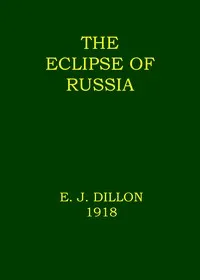
The eclipse of Russia
- Language
- EN
- Format
- EPUB
- Size
- 607 KB
Description
Emile Joseph Dillon's "The Eclipse of Russia" provides a detailed analysis of Russia's political and social structures leading up to the 1917 revolution. The work critiques the Tsardom's predatory governance, highlighting how its institutions and national character contributed to internal instability. Dillon examines the role of ethnic diversity, bureaucratic inefficiencies, and the shortcomings of liberal parties and the intelligentsia in weakening national cohesion. He draws on firsthand experience and references figures such as Count Witte to substantiate his arguments. The book discusses the miscalculations of both Russian and Western leaders, portraying Russia as a "realm of illusions" whose leaders failed to grasp the true nature of the regime and its vulnerabilities.
Written in the early 20th century, the work reflects the period’s scholarly and political perspectives on Russia’s decline. It situates the country's internal challenges within the broader context of European political developments and the imperial collapse, providing a critical account of the factors that contributed to the downfall of the Tsardom and the impending revolution.
Written in the early 20th century, the work reflects the period’s scholarly and political perspectives on Russia’s decline. It situates the country's internal challenges within the broader context of European political developments and the imperial collapse, providing a critical account of the factors that contributed to the downfall of the Tsardom and the impending revolution.
From the opening pages
predatory character of the Tsardom, its incompatibility with the politico-social ordering of latter-day Europe, the pressing necessity on the one hand and the almost insuperable difficulty on the other of remodelling and adapting it to its European environment. It is no exaggeration to affirm that the history of drifting Europe—excluding the Central Empires—during the past quarter of a century, and of the outbreak of the awful struggle at its close, is the story of a tissue of deplorable mistakes—a tragedy of errors culminating in a catastrophe. The delusion of statesmen about the Tsardom, its origins and its drift, are the least blameworthy. For Russia is a cryptic volume to Slav nations, and to Britons a book with seven seals. Her own ruling class constantly misread the workings of her peoples' mind. Even the close observer who classified the strange phenomena that unfolded themselves to his eye seldom traced them back to their causes or realised their various bearings. Between Slav and Saxon, in particular, there yawns a psychological abyss wide enough in places to sunder two different species of beings not merely two separate races. And of all Slav peoples the Russian is by far the most complex and pulling. He often raises expectations which a supernatural entity could hardly fulfil, and awakens apprehensions which only a miracle could lay, yet somehow neither hopes nor fears are realised and, as they fade away, one wonders how they could ever have been entertained. In truth, Sarmatia is a realm of illusions where the goddess Maya is hardly less active or thaumaturgic than in the Buddhist world of shows. Unsophisticated foreigners are bewildered by the contrasts, subtleties, and contradictions that mark the thoughts and acts of the articulate, to say nothing of the inarticulate, Russian nation. In vain they strive to disentangle the skein of events and episodes in which these utter themselves. Nor do they perceive their own errors until it is too late. It is a noteworthy illustration of the easy-going ways of the Entente Governments that they should have accepted as adequate accounts of things Russian the fanciful pictures reflected in the minds of foreigners ignorant of the country, the history, the people, and the language. It fell to my lot more than once to hear the wildest theories propounded by responsible ministers during the war on the strength of such misleading reports, and I have seen political measures…
Ask about this book
An AI guide answers your questions about this title
FAQ
Is "The eclipse of Russia" free to download?
Yes, it is free to download — no sign up needed.
What format is the file?
EPUB.
More by Emile Joseph Dillon



Similar books
Reader reviews Be the first
No reviews yet. Be the first to review this book.
Write a review
Protected by reCAPTCHA.