
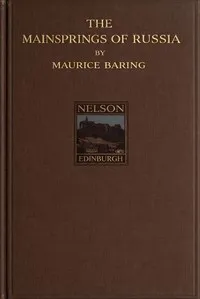
The mainsprings of Russia
- Language
- EN
- Format
- EPUB
- Size
- 403 KB
Description
"The mainsprings of Russia" by Maurice Baring is a social and historical study written in the early 20th century. It explains the forces shaping Russian life and government for a general English-speaking reader, correcting common Western misunderstandings. The focus falls on how geography, history, the peasantry, the nobility, the Church, education, justice, and the state machine interact, especially across the reforms that move Russia from autocracy toward limited representation.
At the start of the book, the author dedicates his work to H. G. Wells and states his aim: to interest the average reader in Russia and avoid being misunderstood, writing briefly and plainly rather than exhaustively. The preface outlines omissions (commerce, the army and navy, and the Jewish question) and situates the study alongside recent English and Russian writings. The first chapter gives a brisk historical backdrop: Russia’s flat geography fostered land expansion; Slavs became dominant; the Mongol yoke delayed Western-style development; Russia later shielded Europe from eastern invasion; Peter the Great created a service state (army, fleet, civil hierarchy, the “tchin”) and tightened serfdom; and moral, practical, and literary pressures culminated in the 1861 emancipation. The second chapter portrays the peasant as the nation’s core—religious, dignified, and guided by common sense—details communal landholding, redemption payments and their cancellation, and Stolypin’s reforms enabling exit from the commune (often pressed unevenly), and shows how poverty, not obstinacy, explains resistance to “improvements,” while credit and education point to eventual peasant proprietorship. The third chapter defines the “nobility” as a vast class of state servants rather than a political or territorial aristocracy, traces its roots in service land grants and Peter’s system, shows its post‑1861 decline as landowners, and highlights how the zemstvos (local councils led by nobles) spearheaded calls for reform in 1905. The fourth chapter sketches the shift from unlimited autocracy to a chartered, still highly centralized system: the 1905 manifesto promises civic liberties and a Duma, and the 1906 Fundamental Laws create a limited autocracy in which the Emperor retains significant powers (veto, dissolution, emergency ukases) while sharing legislation with the Council of Empire and the Duma.
At the start of the book, the author dedicates his work to H. G. Wells and states his aim: to interest the average reader in Russia and avoid being misunderstood, writing briefly and plainly rather than exhaustively. The preface outlines omissions (commerce, the army and navy, and the Jewish question) and situates the study alongside recent English and Russian writings. The first chapter gives a brisk historical backdrop: Russia’s flat geography fostered land expansion; Slavs became dominant; the Mongol yoke delayed Western-style development; Russia later shielded Europe from eastern invasion; Peter the Great created a service state (army, fleet, civil hierarchy, the “tchin”) and tightened serfdom; and moral, practical, and literary pressures culminated in the 1861 emancipation. The second chapter portrays the peasant as the nation’s core—religious, dignified, and guided by common sense—details communal landholding, redemption payments and their cancellation, and Stolypin’s reforms enabling exit from the commune (often pressed unevenly), and shows how poverty, not obstinacy, explains resistance to “improvements,” while credit and education point to eventual peasant proprietorship. The third chapter defines the “nobility” as a vast class of state servants rather than a political or territorial aristocracy, traces its roots in service land grants and Peter’s system, shows its post‑1861 decline as landowners, and highlights how the zemstvos (local councils led by nobles) spearheaded calls for reform in 1905. The fourth chapter sketches the shift from unlimited autocracy to a chartered, still highly centralized system: the 1905 manifesto promises civic liberties and a Duma, and the 1906 Fundamental Laws create a limited autocracy in which the Emperor retains significant powers (veto, dissolution, emergency ukases) while sharing legislation with the Council of Empire and the Duma.
Ask about this book
An AI guide answers your questions about this title
FAQ
Is "The mainsprings of Russia" free to download?
Yes, it is free to download — no sign up needed.
What format is the file?
EPUB.
More by Maurice Baring


Similar books
Reader reviews Be the first
No reviews yet. Be the first to review this book.
Write a review
Protected by reCAPTCHA.